
Bruce Higgins - Early Days Diving
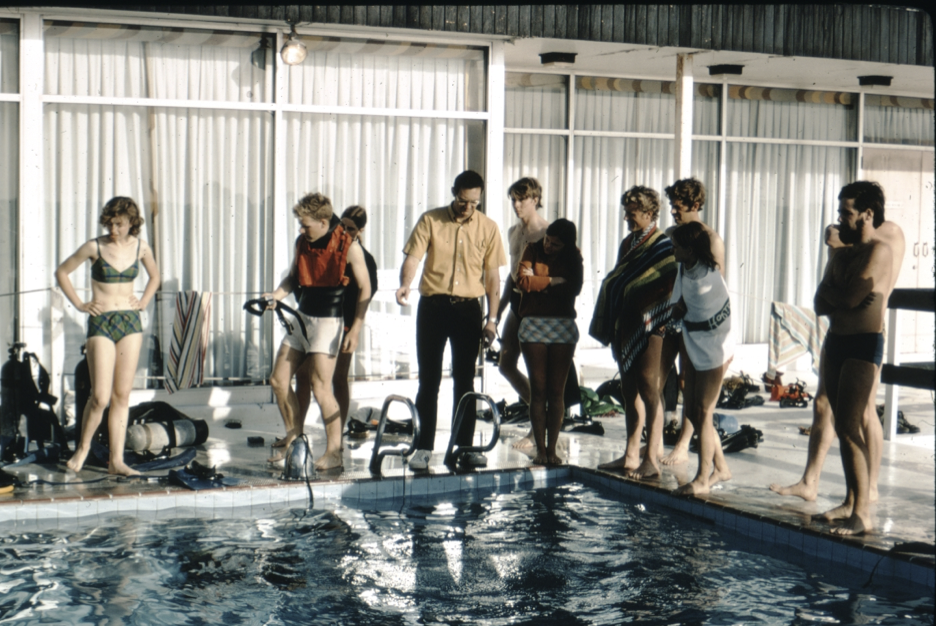
Higgins (vest) and Somers (shirt) at UNESCO - pool qualifications dive 1972 Geology class. (Class staff image)
I learned to Dive at the University of Michigan in PE-111 taught by Lee Somers (NAUI A-13) Jan-May 1970. This was Lee's first large class and I was an overload student so I had to provide my cylinder, regulator, and backpack besides typical MFS. June 1970 I complete my open water dives in a lake just north of Ann Arbor as Certification was not required for a grade and due to my exam schedule I waited a few weeks.
The fall 1971 I became the Diving Safety Officer for Great Lakes Research Division at the University of Michigan as I had worked on their research vessels for 2 years (one year as a diver at that time).
Spring break 1972 as part of a Carbonate Environment Geology Class I was able to dive at Hydrolab in Freeport Grand Bahamas where I was studying sediment transport. The scuba support was hosted by Al Tilman (NAUI #1) and Dave Woodward (NAUI #8xx) at UNESO. Lee and the other instructors were scoping out Hydrolab for a project in June 1972. Early summer 1972 I attended a program at Woods Hole Oceanographic Institute working on a drifter study of Narragansett Sound.
August of 1972 I attended a Research Diver Program Lee Somers hosted in Grand Traverse Bay where our big week long project was to install Lakelab in Omena Bay which was the University's habitat funded by Michigan Sea Grant. The 9 day program allowed me to experience surface supplied diving and many of the subjects now taught in an Advanced Class. Summer of 1973 I helped staff the program's second year still funded by Michigan Sea Grant.
Late summer 1973 attended a NAUI ICC in Chicago which I failed for mostly not being speedy enough as a swimmer and not having completed my WSI training. But learned lots about NAUI and made some long term friends. I came away with a study plan to return in the future to another training event. My biggest takeaway was I learned how to plan lessons which helped me with my Masters work at Oregon State University. Also these skills got me a teaching assignment at Shoreline Community College in Oceanography, Ocean Technology, and Electronics in 1976.
In 1975 I completed one of the early NAUI Assistant Instructor programs hosted by Bruce Nyden (NAUI #2186) who was teaching a NAUI scuba program at a near by YMCA and met a number of other NAUL, PADI, and NASDS instructors while being the President of the OSU Sea Beavers for a year. Nyden ran me through an advanced diver program where we dove a number of Puget Sound, Straits of Juan Fuca, and Yaquina Bay dive sites.
Moved to Seattle in 1976 and got connected with Bill High (NAUI #175) who was teaching the Shoreline C.C. Scuba Program (PE-140). This allowed me to continue learning how to instruct diving classes at scale. In 1977 1 completed a NAUTITC in Port Townsend, WA at Fort Worden where again I met a batch of NAUI folks who I was connected with for years.
My oceanography teaching stint at SCC ended in 1979 and in 1984 took over PE-114 for Bill High as he was up to his eyeballs as NAUI President and for a while PNW Branch Manager.
In 1976 started a research diving company - Marine Concepts - where I was doing research diving assignments for Battelle Marine Sciences Lab in Sequim, WA. Most of the contract work was for Exxon about Dungeness crab behavior. Battelle and I bid on a King Crab Project for the MMS in the Bering Sea on NOAA Research Vessels in 1982. So I spent about 9 weeks on three cruises researching juvenile King Crab on the SW Alaska Peninsula. My connection with Battelle resumed in 1989. Later I worked as a researcher for Battelle MSL in Sequim and spent two springs in Prince William Sound on Pacific Herring for Exxon in 1989 & 1990 following the Exxon Oil Spill. The Lab had an active diving program and I became DSO for them. Had a chance to participate on a 3 year global climate change project which involved measuring bubbles for gas exchange and some diving as well funded by the Dept of Energy until Battelle re-organized in late 1995.
I started in 1979 pitching in on NAUT ITC's when they were a NAUI Branch activity with them being odd years hosted in Seattle. Eventually work up to becoming a Course Director in 1987 and hosted my own in 1988 an ITC in Seattle. Scott Munro and I later co-hosted ITCs at Pullman until 1997 when Barry Moore coordinated WSU aquatics. My career changed as did NAUI and I became Sustaining then Emeritus.
Notable tangent was in 1985 with Dr. Mike Powell at the Institute of Applied Physiology and Medicine offered an evening class on Diving Physiology. I attended his program and then assisted Mike with some additional classes. This lead to me having a contract with him to do the data gathering and organization for the PADI Recreational Dive Planner's human subjects testing done at IAPM in 1987. I was part of the Doppler crew which sampled divers post dives at their chamber, at Edmonds' Unocal Dock, and in the San Juan Islands. Learned a lot in this effort about Deco.
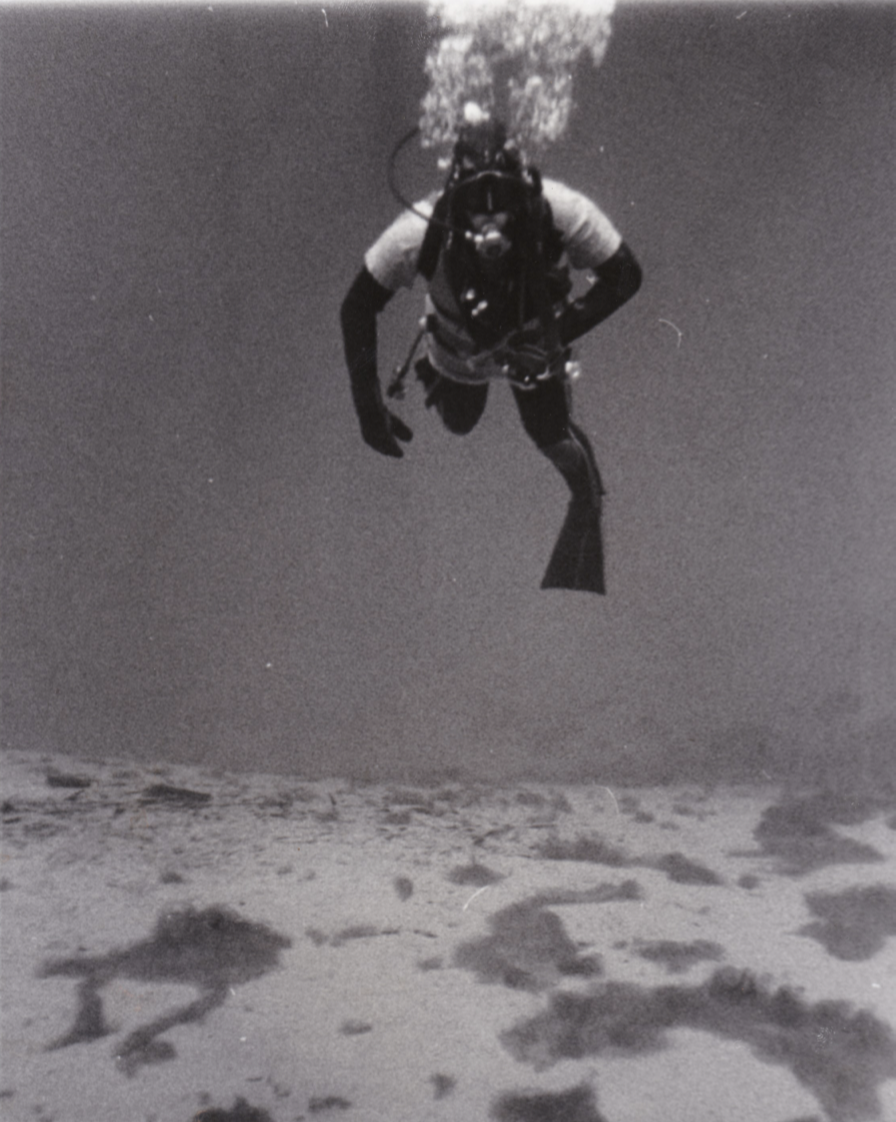
John Ratliff photo of Bruce Higgins in Clear Lake, Or. Summer of 1975ish. (Sporting Duck feet, Calypso camera with flash bulbs, octo, UDT vest, and T-Shirt for visibility)
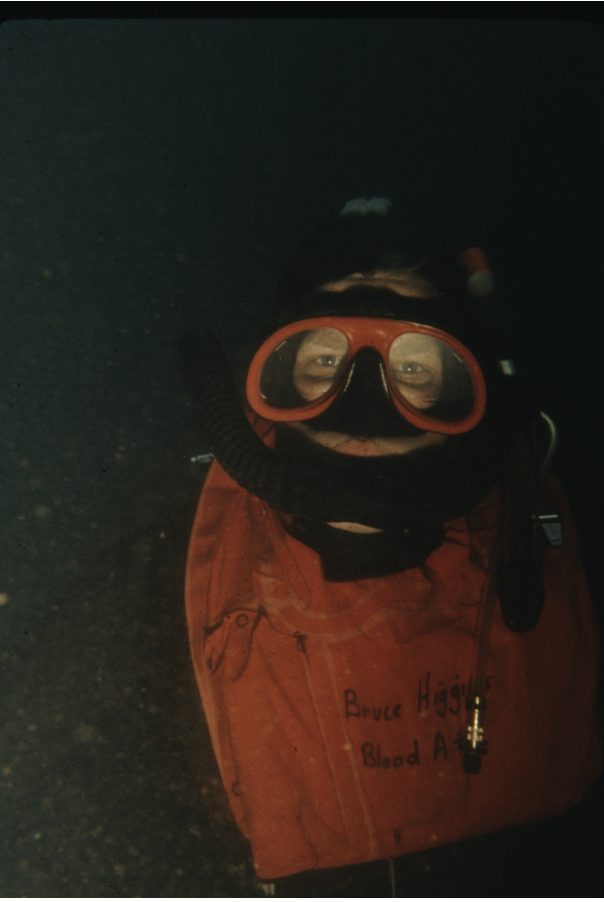
Higgins on early dive with Safety Vest converted to B.C. with two hose (Mistral) 1975ish (John Ratliff image).
Edmonds Underwater Park In 1970 the City of Edmonds established the Edmonds Underwater Park and efforts there were hosted by two NAUI Instructors (Bob Barringer and Jim McMahon) from their dive store in north Seattle. I made my first Park dive in 1973 while I was assisting Ron Corkum's NAUI Openwater Class on an adventure north from Corvallis. In Fall 1976 when I moved to Seattle I started diving the Edmonds Underwater Park and got connected with Jim Walton who was placing a reef for Wash Dept of Fisheries for the Edmonds Fishing Pier Fall 1976. (This was part of his PhD thesis and I had met Jim at the UM fall 1973.) Helping him place his reef was interesting. Also since there was a public meeting about improving the Edmonds Underwater Park as mitigation for divers not being allowed at the Fishing Pier. Post meeting I recruited a student (Les Bolton, a PADI Instructor) who wanted to do a biological survey of the Edmonds Underwater Park as a special project for my Oceanography Class into helping me map the Park for both his report but also for the mitigation efforts by WDF. This mapping effort allowed me to cross connect with the City of Edmonds.
Come 1977 the City had an issue with Edmonds Underwater Park in that there were 5 fatalities in the Park and one additional one at Marina Beach (the Unocal Oil Pier) that year. So the City's Mayor formed a Diving Safety Committee and I was a member as a newly minted Instructor and former DSO. As an outcome of this Committee the City fabricated two rest floats funded by Bill High for diver support and I acquired via SCC 3 marker buoys from NOAA to use to define the Park's boundaries in 1978.
That was how I got connected to the City of Edmonds and in 1979 when the Mitigation Reef was placed it was my mapping effort which defined the permitted site where WDF placed the concrete and material. I did get to dive with WDF post placement to stabilize the material.
Along comes 1982 and Divers Institute of Technology offered the City of Edmonds the Hull of the Fossil - a 65 ft wooden tug boat. I helped with the placement and permitting which became the real anchor between our stewardship effort and the City as we had been keeping the cables on the rest floats in good shape which likely was invisible.
In 1983 after a talk by Spence Campbell (NAUI #A-20) about diver trails we had the material to place some at Edmonds to connect divers to and from the new tug hull and shore. Vaughn Fierke and I puzzled out how we might accomplish this at Edmonds and he handled the concrete blocks and I coped with the lines. This diver trail system was an effort for safety as Spence mentioned navigation in our waters is not a natural skill and takes time to perfect. Over time this system is now over 2 ½ miles long which forms a grid system magnetic N-S and E-W.
Once the City thought our stewardship group was valuable communications improved. We then started placing other features and trails to keep divers farther north away from the active ferry terminal along the south Park boundary.
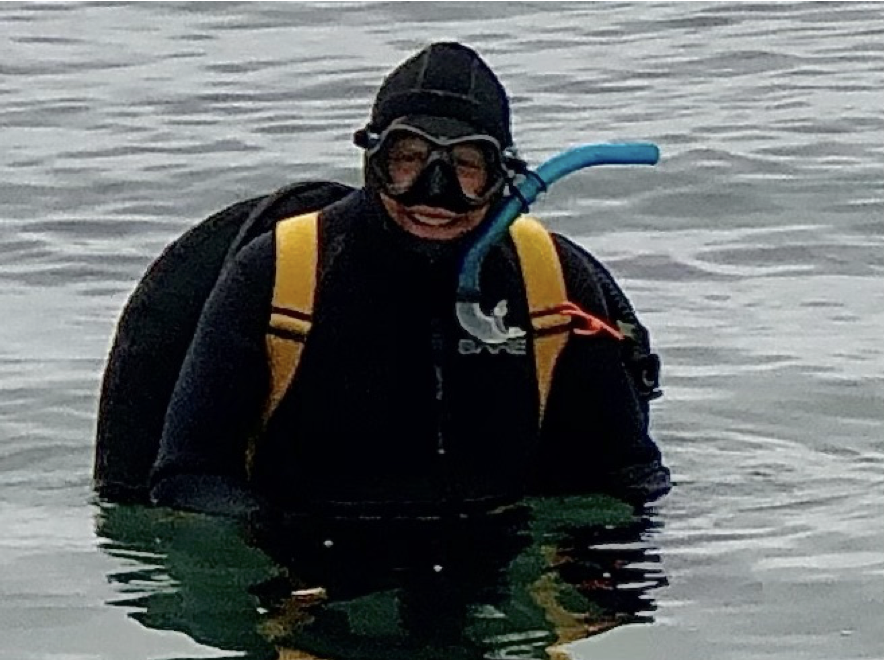
Bruce Higgins off to dive Edmonds - recent (2020 image)