Diving the Stump
Today you can open almost any scuba magazine and find articles about travel diving in far-off places. The dive sites always seem to carry evocative names: Manta Reef, The Purple Wall, Rainbow Ridge, Shark Pinnacle, Grouper Alley, and so on.
Sixty years ago I discovered my own exotic location, which I named The Stump.
Well, it wasn’t quite as glamorous as the places featured in glossy dive magazines, but it seemed pretty amazing to me.
I was twelve years old and new to the underwater world of Puget Sound. Our family had moved to the small town of Des Moines, about twenty miles south of Seattle. Today the city has a large marina along the waterfront, but back then it was nothing but a long stretch of sandy beach.
After growing up on a farm in the arid country of eastern Washington—where we mostly grew sand and tumbleweeds—Puget Sound offered a radically different world for me to explore.
I bought a set of Voit flippers, mask, and snorkel at Value Mart, along with a three-pronged spear point that I mounted on the end of a six-foot wooden pole. I couldn’t afford a wetsuit, but it was summer and the surface water, warmed by the sun, wasn’t too bad. My parents were kind enough to drive me down to the beach so I could snorkel in the shallows while they sat reading books and enjoying the breeze off the Sound.
I’ll never forget those first dives.
The thrill of floating over the sandy bottom while little flounders and sculpins darted this way and that. Crabs scuttling sideways at my approach. Striped perch hovering around sunken rocks, pecking at barnacles. Sea anemones rising from the sand or clinging to old logs. Moon snails slowly plowing their way across the bottom.
The water felt ice-cold at first, but once my body numbed it became bearable. I could snorkel for an hour or more before returning to the beach, shivering but completely smitten with the underwater world.
At first I speared anything that moved—the hunter-killer instinct of a twelve-year-old boy. This mostly amounted to small flounders or bullheads. Once in a while I managed to spear a perch, which we took home and ate. The fillets were tiny though—a lot of work for something resembling miniature fish sticks.
After a while I grew bored with killing. I still carried the spear pole, but mostly as a mental crutch to ward off my ever-present fear of sharks.
Sharks that never showed up.
One day I was snorkeling farther south than usual when I noticed a cluster of kelp bulbs floating on the surface. The water out there was deeper—perhaps twenty feet—but curiosity pulled me toward it. As I approached the kelp patch I saw something large and dark resting on the white sandy bottom. The kelp was attached to it. A school of striped perch milled around the structure.
I took a deep breath through my snorkel and dove down to investigate.
That was my introduction to The Stump.
It was exactly what the name implied—the waterlogged remains of a once-mighty tree. The root system alone would have filled a small room. From the root ball the trunk rose about six feet before ending in a flat surface nearly eight feet across where someone had cut it off with a chainsaw. How long it had been lying there I had no idea, but it was well coated with barnacles, and several sea anemones had made it home.
I absorbed all this in a quick glance as I glided down alongside the kelp stems.
Then, just as my shadow passed over the stump, something huge darted away in a tight circle and disappeared beneath the roots.
I didn’t get a good look, but I saw enough to know it was a fish—and a big one.
My heart started pounding.
I surfaced, took several deep breaths, and dove again.
This time, as I probed beneath the root mass, a second large fish blasted out from under the stump and rocketed around the backside like a dragster. The sudden blur of motion scared the bejeezes out of me.
The fish was squat and thick, mottled in color. I had never seen anything like it—certainly nothing that big.
Although striped perch cruised around the stump in numbers, I ignored them. The same went for the flounders carpeting the sandy bottom.
My goal now was to get one of those big mystery fish. After several dives around the root mass, peering under branches and crevices, I finally spotted one. It was wedged between two roots, barely visible.
I returned to the surface, took several forceful breaths to clear my lungs, then dove hard for the bottom.
Hovering above the fish, I jabbed downward with my frog gig. I felt the three tines punch home—and nearly had the spear ripped from my hands as the fish exploded in a violent thrashing.
It bolted for open water, tail beating powerfully. I knew that if it pulled too hard the spear would tear free, so I shoved downward with everything I had and managed to pin the fish against the sand. I pushed so hard that the tines drove deep into the fish—right into its spinal column.
The fish shuddered once and went limp.
A good thing, too, because I was completely out of breath. I grabbed the shaft and kicked for the surface with my prize.
Underwater the fish had seemed enormous—so big that I was actually a little afraid of it. Even now it looked formidable, hanging from the spear tip and quivering slightly. It had a huge head and a wide mouth lined with raspy teeth. Short, thick, and heavy-bodied, it resembled the little bullheads I had speared before—only much larger.
I was so excited that I didn’t even notice how blue I had become from the cold.
My parents were more than a little surprised when I emerged from the water with my trophy.
The fish weighed nine pounds.
After consulting a fish book, I learned that it was a cabezon, a member of the sculpin—or bullhead—family that can reach thirty pounds. They are considered excellent eating, despite the fact that their flesh often has a greenish-blue tint from their diet of crabs and other crustaceans.
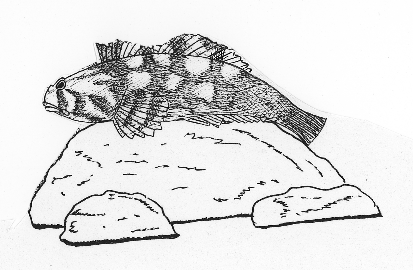
Cabezon, sketch by David Peters
We ate that one. It was delicious.
It never occurred to me to write a travel article for a dive magazine describing The Stump.
Somehow I doubt they would have read past the title.
The Stump soon became my first true destination dive site—an underwater place I returned to again and again. There always seemed to be cabezon living among the roots. Sometimes I would see four or five perched around the old tree. On later dives I spotted rockfish, piling perch, and tomcod. One day a large skate appeared, lying half-buried in the sand beside the stump. There was always something new and fascinating around that tangled mass of wood.
That summer alone I must have made forty trips out to visit it.
Who says you have to travel to the tropics to find an exotic dive site?
Apparently all you really need…
…is a stump.
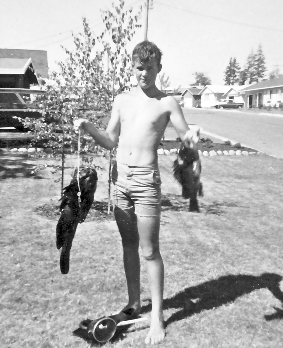
Author and his first cabezon and rockfish, 1964