Diving on a Freeway
By Eric Morris
Very early one morning Dan Keffler, one of the commercial divers from Underwater Sports dive shop in Seattle, woke me up with his phone call.
“Hey Morris! The Hood Canal bridge sank last night. Yep, really! 100-mph winds sank it. Waves ten to fifteen feet tall. The Department of Transportation wants us to go dive on it this morning and see what happened, take some pictures. Get up here right away.”
The Hood Canal bridge had been built in 1961 to connect the Olympic Peninsula with the eastern half of the Puget Sound area. It consisted of one and a half miles of huge concrete pontoons, fifty of them, linked together by four immense steel cables.
On a reduced scale it was rather like fifty rectangular beads strung on a necklace and pulled in a straight line.
A separated four-lane highway was built above the pontoons. At each end of the bridge, Warren Trusses led from the land onto the floating pontoons. These could tilt up or down to keep the highway connected to the pontoons as they rose or fell with the sixteen foot tides.
At the time it was built, the Hood Canal bridge was the third longest floating bridge over saltwater in the world.
I was still half asleep and at first I thought Dan was kidding, but it turned out that 100 mph winds had swept across the canal that morning and as the wind velocity increased, the bridge watchman had closed the span to traffic. During the darkness of the early morning hours—and unseen by anyone—the western half of the floating bridge went missing. The remaining bridge simply stopped about two thirds of the way across the canal, leaving a chasm of open water between the end of the bridge and land to the west.
Naturally, the Department of Transportation had questions.
Did the massive cables which linked the bridge sections together part?
Or had the concrete pontoons cracked and flooded under the stress?
And where were the pontoons?
Did they sink straight down or had they floated off?
If they sank in position, could they be raised?
The D.O.T. wanted some immediate answers.
Since Underwater Sports had been providing bridge cable inspections for many years, they had called us for the preliminary investigation. They wanted underwater pictures of whatever we discovered.
Dan and I had been doing most of the cable inspection and cleaning the previous summer, so we answered the call. We hitched up the sixteen foot Avon inflatable to the dive shop’s van and drove out to the bridge site.
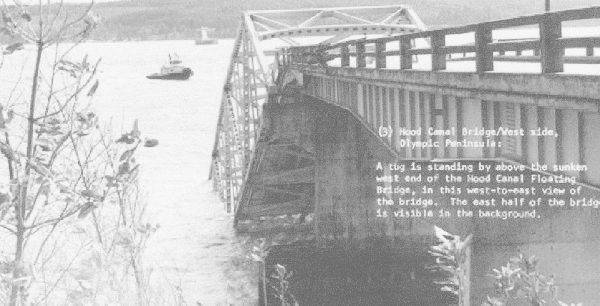
It was downright bizarre to see a half mile gap where once there had been the visual and physical presence of a major road across the water. The floating pontoons portion of the western bridge had simply vanished. Nobody was going to be driving across the canal for a long, long time.
We launched the Avon and motored across to the west side where four D.O.T. engineers and department heads awaited us at an access point on the beach, just to the north of the Warren span. After a quick briefing with them, Dan and I suited up.
We caught the tail end of slack high tide and entered the water beneath the surviving pylons that supported the Warren Truss—the section of bridge that normally transitioned the highway onto the pontoons. Except there were no pontoons anymore.
The Warren Truss dropped right into the water.
Due to the windstorm, the water was all stirred up and muddy. Trees and other debris floated past. I doubted we’d get any good pictures at all, but Dan took down his Nikonos camera system just in case it was clearer on the bottom. At thirty feet of depth, visibility was as bad as we’d expected from our topside survey—about three feet.
We swam around the south side of the sunken Warren Truss and out into the channel, straining to make out shapes in the swirling, silt-laden water. The tide was already running strong. We pulled ourselves along the bottom to keep from being swept away. The hulk of a sunken concrete section loomed over us, blocking out the rest of the ambient light.
We started up the side and found four massive steel cables entering the pontoon. Each cable must have been three feet in diameter.
Dan and I swam over the side of the pontoon and found ourselves standing on a blacktop freeway—yellow stripes and all.
“Never thought I’d be diving a freeway,” I thought to myself, as we finned down the street. “Just follow the yellow dashed road.”
The pontoon was deeper at the east end and the water darker still. Each section was 360 feet long and we just kept following the lane stripes. Finally there was a slight gap in the road, then the next pontoon hove into view. We crossed over to the new pontoon and continued down the asphalt. The slant of this pontoon section was steeper as it pointed to mid channel and deeper water. We continued following the yellow striping down the roadway. At this depth the murk prevented virtually any surface light from penetrating to the bottom, forcing us to rely solely on our powerful dive lights to illuminate the way.
We continued onto the third pontoon. So far all three had been lying end-to-end like a row of gigantic, sunken shoe boxes, but when we reached the far end of the third pontoon—only blackness greeted us.
Pontoon #4 was simply missing!
Dan and I dropped over the end of the roadway and descended to 120 feet.
Four large, perfectly round holes penetrated the end of the pontoon—but no wire cable came out.
Somewhere inside of pontoon #3 was the answer.
Dan and I moved around to the south side of the sunken concrete float until we found an access door which led inside. It wasn’t locked. We opened it, checked our air—we still had two thirds of our supply—and went in.
Visibility inside the pontoon was much better than outside—about ten feet because it was dead water with no currents to stir up the silt. Our lights illuminated a bare concrete floor. A saturated paper towel floated across the room like some vaporous ghost. The ceiling height was twelve feet, much taller than a normal room. A dividing wall ran down the middle of the pontoon, in effect making two long, narrow rooms. Attached to the ceiling were all sizes of metal conduits running the length of the room. Every ten feet or so hung over-sized electric light bulbs, nearly a foot long.
Our exhaust air bubbles trickled to the ceiling, rolling and rattling along as they sought the high end of the rooms. Dan and I moved carefully west inside the submerged pontoon, nerves taut. Two hundred feet later, the answer of why the Hood Canal bridge sank stared us in the face.
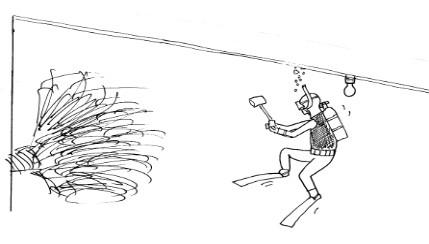
The pontoons not only had lengthwise walls dividing the giant boxes in half, they also had inner bulkheads running side to side, dividing the interior space further into grids. Just outside the first bulkhead wall, looking for all the world like gigantic, steel wool bird nests, were the remains of the cables.
Under the incredible pressure of 100 mph winds, the cables had simply parted.
The pressure of bursting cables had exploded the twisted strands into a Medusa’s head of wire that snaked and twisted every which way, almost filling the bulkhead wall from top to bottom.
While I took both lights and shined them upon the cable ends, Dan moved closer to take some pictures. He snapped off a couple, then backed up a few feet to get more subject into the viewfinder.
Suddenly, there in the darkness of an underwater concrete tomb, 200 feet from the exit door and 120 feet deep, came a deafening KAWHUMPP!
Startled, I rotated and pointed my lights towards the sound, expecting to see a pile of concrete rubble trapping us inside.
Instead, much to our utter relief, the pieces of one of those big light bulbs floated down—Dan had accidentally backed into it with his tank and the bulb had imploded violently under the considerable pressure at that depth—its resonance magnified by the submerged room.
Dan looked at me—I looked at him—and we both sprinted for the exit.
That imploding bulb produced a pucker factor of TEN!
We slipped out the door, swam along the freeway towards the beach as fast as we could go and didn’t stop until we reached dry land and were twenty feet up on the gravel service roadway.
We eventually filled the D.O.T. folks in on what we’d found. The concrete had held—the steel cables hadn’t.
Only three bridge sections were sunk in place—the rest were presumably resting far out of alignment and sunk in deep water.
Dan took the roll of film out of his camera and gave it to the engineers for developing. We never heard how they turned out.
In later weeks, further inspection by other divers revealed that some pontoon hatches had been opened, either by explosive water pressure as the floats sank or by personnel who forgot to dog them down properly. It was believed that enough water leaked into the pontoons that the weight of the sinking roadway plus the pressure of the winds combined to cause cable failure.
A replacement bridge was built using floats that were 50% stronger and wider. After three and a half years the span reopened at a cost of $150 million.
I am still in contact with Dan Keffler.
To this day, whenever I run into him, I ask if he’s popped any light bulbs lately.
He still doesn’t think it was funny.