Sea Stories
SCUBA Tales
The Golden Age of North Pacific Underwater Adventures
Introduction
If we accept 1950 as the approximate beginning of modern or new era diving in the US, then we have a 70 plus year history. A short time perhaps in the minds of some but still the time when diving's growth curve was at the steepest rise. There are many stories to be told by the pioneers and today's divers.
A few pioneers are still with us to offer (when asked) a continuity between our beginning and the rapid pace of diving development. Today all too quickly those who made diving a high adventure sport are moving on in one way or another. They are lost as a resource for the harsh facts of diving history or the once-in-a-lifetime report of being present when a first took place.
Our current divers are experiencing new equipment designs and equally adventurous dives. Will divers of the of the year 2030 or even 2050 feel a loss because they have too few records to trace diving history and the adventures? History tells us that people do want to have an accurate picture of what came before them.
Should we not act while those who led scuba divers into the sea, lakes and other waterways can still relate the magic of history? Our new divers have new stories to tell. We must hear from them too!
The booklet SCUBA TALES invites ALL divers to recall, record and submit a short story about their underwater experiences. Bill High, Editor, Sherry Gresham Technical Assist.
Table of Contents
Pennzoil Commercial by Bill High
Safety Church by Bill High and Mark Gresham
Puget Sound Trawl Dive by Dan Twohig
Take Me To Your Leader by Jim Willoughby
A Research Intruder by Bill High
A Trawl Dive Too Deep by Gary Loverich
Jerry’s Treasure by Bill High
Sherry’s Between Top and Bottom by Sherry Gresham
Invasion by Bill High
Squid by Jim Willoughby
Catching Porpoise for Science by Gary Loverich
The Basics of Salvage Law by Dennis Lucia
Starfish by Gary Loverich
Octopus Friends by Tom Hemphill
Apollo 13 by Bill High
Trust but Verify by Mark Gresham
Did the Underwater Have Eyes by Dennis Lucia
The early days for Edmond U/W Park by Bruce Higgins
No Nitrox for You by Mark Gresham
The Boat Motor by Mark Gresham
Lopez Pontoon by Bruce Higgins
A Chilly 10 Minutes by Jim Willoughby
And now our stories begin!
Pennzoil Commercial circa 1975 by William (Bill) High
In the late 1970’s a film company shooting a commercial for Pennzoil Petroleum asked me to find octopuses, be the battling hero and otherwise ensure they got great underwater footage. The underwater crew consisted of one cameraman, two light holders, a safety diver, and my diving partner Laurel Touchette was to be in the scenes with me as the attractive damsel fighting the mighty octopus. The safety diver provided the boat and diving supervisor who we were told would run the boat topside.
We found our featured actor hiding beneath the sunken ship M/V Dauntless. There was some danger because a fisherman’s gill net was entangled in parts of the ship wreckage. Together, Laurel and I got the large animal out of its den while the cameras rolled. With good footage acquired, the octopus jetted away. To my surprise the creature was promptly followed by the entire film crew and safety diver. I was very low on air and turned to find my partner entangled in the gillnet. She was experienced enough to just quietly begin the disengagement process. I had no choice. I raced to the surface to get another cylinder. I called for the nearby boat but promptly learned that the so-called diving supervisor was the girl friend of the safety diver and did not know how to operate the boat nor to rig another cylinder. I swam to the boat, spoke very impolitely to the worthless individual while fearing for the safety of my partner as she must also be low or out of air by this time.
Upon reaching the wreck, I found Laurel just finishing the task of clearing her equipment and we both ascended to the surface. I would have been less concerned had I recalled that she used far less air than I and her cylinder was a bit larger than mine, so she had no air shortage. The safety diver and his “supervisor” were fired. He was supposed to remain with us at the wreck because of the entanglement danger but was caught up in the thrill of the octopus’s chase.
Safety Church2006By Bill Highand Mark Gresham
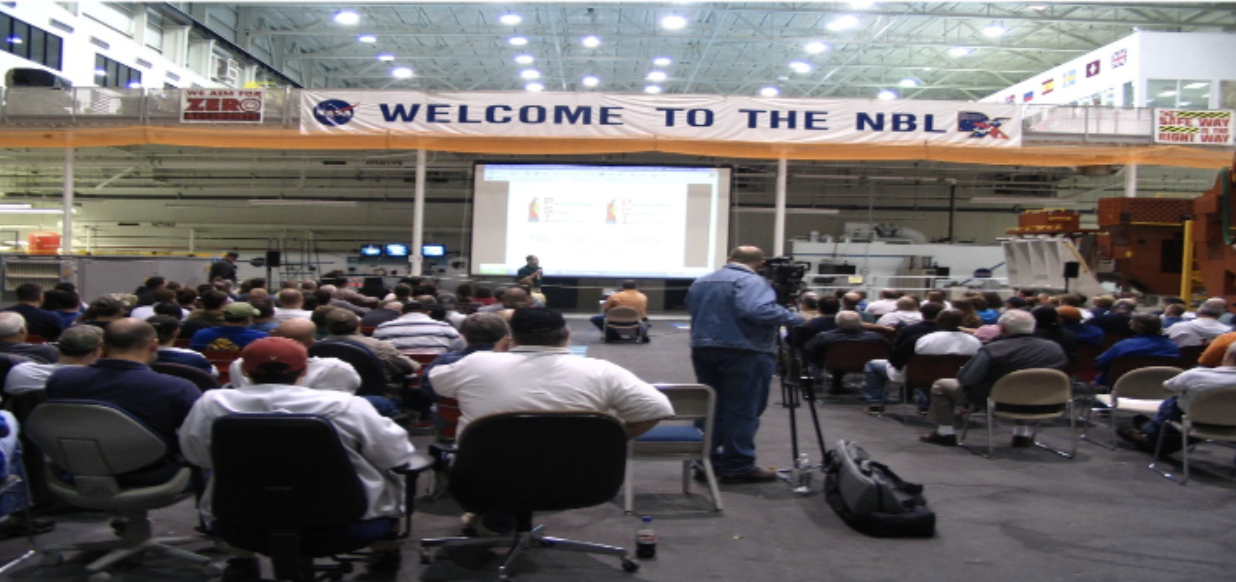
As you can imagine, NASA is especially dedicated to safe practices in all components of its mission. That is particularly true at NASA’s Neutral Buoyancy Laboratory near Houston, Texas. That laboratory is where Astronauts, in a 1.3-million-gallon pool simulate weightlessness for spacewalk training. Professional Scuba Inspectors, Inc. trains both Astronauts and support technicians there in scuba cylinder safety practices. In 2006, we went to the Lab on a training assignment. Mark was invited to make a short cylinder safety presentation while there to a Johnson Space Flight safety managers quarterly meeting.
Near the appointed time, we were escorted to what we assumed would be a typical conference room. Much to our surprise, it was not a conference room at all but rather a huge operations space in the hanger cleared and refilled with seating for about 200 employees. Mark gave his talk following some opening announcements. The audience was attentive and applauded loudly at the presentation’s conclusion. Those 200 employees seemed exceptionally tuned in to safety matters.
Next came a speaker with microphone in hand. He was impeccably dress in a blue polyester sport coat. His voice quickly rose to a near fever pitch. He implored the audience to think and live safety. He gave a rousing safety message and then, with even more enthusiasm, asked the audience how they had recently contributed to safety on the job. He reminded me of someone I had seen before and I turned to Mark to express “My GOD, we are in safety church”. No evangelist preacher out did this fellow.
Attendees were eager to and urged to come to the microphone to share a safety related experience. And, just as in church, audience members came forth to share. Each experience was received with thunderous applause and our Safety Preacher presented the “confessor” with a safety tee shirt.
We both have been in the on-the-job diving safety business for many years but never before nor since have either attended safety church.
Puget Sound Trawl Dive circa 1971 by Dan Twohig
In the early 70s our fisheries research team conducted a dive on a commercial fishing trawl net at a depth of about 90 feet. I had recently obtained the first Unisuit in the Pacific Northwest and it was my first net dive using it.
We divers jumped off the fishing boat and followed the tow cables to the net moving along the bottom at about 3 knots. A motor launch followed as the diver pickup boat. A bit after settling on the net headrope with one arm over it to hold on, I noticed it was becoming difficult to hang on.
When I kicked to reduce the strain, nothing happened. It was like my feet were no longer in my fins. About that time Gary Loverich who was alongside me noticed I was having trouble. The expression on his face said something was seriously wrong. Quickly, I could not hang on anymore. Gary reached out and grabbed my hand trying to hold me next to the net. Unfortunately for me, he could only hold on for a short time. When I slipped from his grasp, I found myself in a rapid uncontrolled assent to the surface. I popped completely out of the water and ended up on my back,laying spread eagle.
Pete Larson the chase boat driver and experienced diver came alongside and opened the Unisuit zipper to let out the air. The suit was blown up to the point where I could not move my arms to manually reach the bleed valve or zipper.
The dive post analysis was that when I put my arm over the trawl headrope to hold on, one of the net’s floats was up against the suit’s air fill valve located on the Unisuit chest. The valve was pushed open adding air to the suit. The air inflating the suit was forced to my legs and feet by the three-knot current, so my feet were no longer in the fins. It was an exciting ride and I always paid attention to the fill valve during future dives.
Take Me To Your Leader circa 1950 by Jim Willoughby
I began snorkel diving in 1949 when I was 19. I lived in a quiet little village in California, called Carmel-by-the-Sea. The diving was great in this area. You have to remember, there were very few divers in those days. Sooner or later you would meet other divers on the beach. Eventually, five of us got together and formed a small diving club. You might think that the name of the club is Mickey Mouse. Believe me, to dive back then, with the available equipment and lack of knowledge, was a long way from Mickey Mouse. We finally decided on the unlikely name of Carmel Bathing Association! The president’s nickname was Monk as he had a ring of thin hair around his bald head. Then there was Crusher, who was a big man, 6 foot 2 inches tall, weighing 220 pounds. The only woman in the club lived 100 miles north, in San Francisco. She would fly down to Carmel about twice a month. Because her luggage on the plane was limited to only a few pounds, she would wear her weight belt under her coat, to avoid paying the extra cost. We called her GG after the shabby character in the Dick Tracey series. When GG was combing her hair, and ran into a knot, she would take scissors from her pocket and cut it out! Lest we forget, Godzilla. He was movie-star handsome (and knew it), weighed in around 275 pounds and was 6 foot 4 inches tall. Nobody messed with Godzilla! My nickname was Santiago, as I spoke fluent Spanish.
One of our favorite dive spots was a deserted beach south of Carmel. The biggest drawback was that you had to park your vehicle up on the highway, then walk quite a distance to the beach. We had just finished a great dive, with clear water, a big kelp bed, and lots of marine life. As we swam underwater back to the beach, Monk spotted a large sunflower star. These are the largest sea stars in the world. They grow to one meter across and have 20-24 arms. Monk picked up this huge, bright orange monster and put it on his head. The arms draped over his head down to his shoulders, and over his mask. When we got into shallow water, we all stood up.
Picture this……We left nothing of ours on the deserted beach, as we had put on our diving gear up at the car. Monk still has the sunflower star draped over his head and we all had pole spears. Please remember that divers were rarely seen in those days. As we all stood up in the shallow water, believe it or not, two nuns were walking along the beach right in front of us. Well……Monk, our president, ran towards them with his pole spear in his hand and the bright orange sea star on his head. As he approached them, he hollered “Take me to your leader!” The last we saw of the nuns were two black robes flapping in the wind and a female voice praying loudly “Yea, though I walk through the valley of the shadow of death……”.
I will never forget the memorable times I had with the Carmel Bathing Association.
A Research Disrupter circa 1975 by Bill High
In preparation for a large study of the impact of “ghost” or derelict king crab pots near Kodiak, I did a test of the planned protocol by using Dungeness crab in Puget Sound. I set several pots north of Seattle offshore Carkeek Park containing tagged crab. Every other day I would dive down to check for escape or mortality.
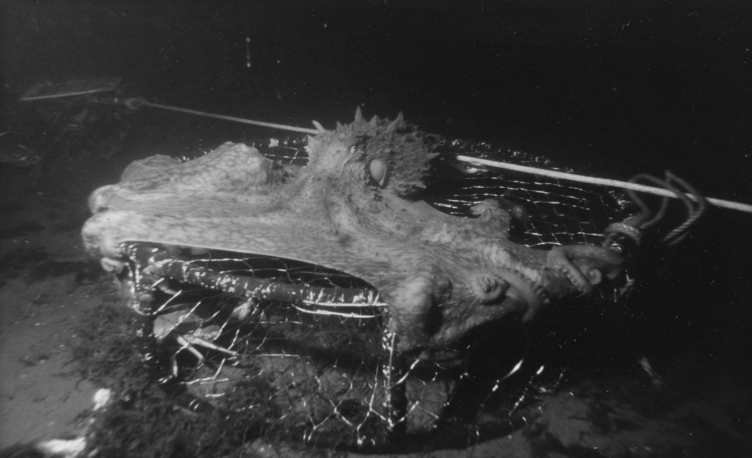
One day upon arrival at one pot, I found a 40 plus pound octopus setting on top. I have been studying octopi’s behavior since 1957 (National Geographic published a report of my work in its December 1971 issue) so was particularly interested in what was going on. I approached it face to face. It seemed to glare at me while reaching through the pot meshes and holding a couple of my test crab. Fortunately, the octopus could not pull them out through the meshes.
I pulled the unhappy creature off the pot and swam it about 15 ft away. I then proceeded to lay my clipboard on the pot and began taking notes. The octopus “walked” back to the pot, climbed between my arms, and sat on the clipboard. Then it glared fiercely flashing its skin from red to white and back. I was running low on air so had to terminate the interference. I again picked it off the pot and carried it off a short distance.
Not to be bullied by a diver, the octopus started back toward the pot. I took a dead crab from the pot then swam out to meet the intruder. It stopped, reached out with one arm, assessed the hand that proposed to feed it as well as the food itself. It neatly picked up the crab, tucked it beneath its mantle and swam off.
.
A Trawl Dive Too Deep circa 1971 by Gary Loverich
Our National Marine Fisheries Service gear research dive team dove on a large mid-water trawl at a depth of 115 to 130 feet with the sea floor at about 500 feet below us. when I dove over 100 feet, I felt a bit too relaxed and too confident, perhaps the early effect of narcosis. Happy to be here, thank you. What a wonderful place to work, thank you again. With our work finished we four divers released our hold on the moving net and found ourselves in “still water” watching the net’ bitter end disappear into the surrounding gloomy.
At 115 feet or more, we were suspended in mid-water with no object, or boundary (surface or bottom) to give us some orientation. We only had the direction of our bubbles. There was no clear source of illumination, just an attenuated and dispersed green gloom from nearly all directions.
We formed a tight huddle facing each other and swam vertically toward the surface slowly and methodically. I noticed that it was getting darker. I kept asking myself “why is it getting darker?” I can still remember thinking that but had no compelling reason to try for an answer since I felt comfortable, still very happy to be there. Team member Ian Ellis suddenly pointed to his depth gage to get our attention with vigorous hand motions. He pulled the small air canisters on our vests to inflate them and increase our buoyancy. We all then realized that we had been sinking rather than ascending. We had been kicking toward the surface, but our wet suits had compressed to a fraction of the original thickness so we were negatively buoyant, sinking that is. Ian saved us from “a bad situation” and perhaps ending up in the Deep Six of Puget Sound where our bones might still be today. We clearly went too deep. It was just part of the learning experience. What doesn’t kill you hopefully makes one smarter.
Jerry’s Treasure circa 1968 by Al Beale and Jerry Gray as told to Bill High
Al and Jerry, two great diving friends from the Portland, Oregon area, shared a great story with me back in the early days of diving. Sadly, both have passed but the story lives on.
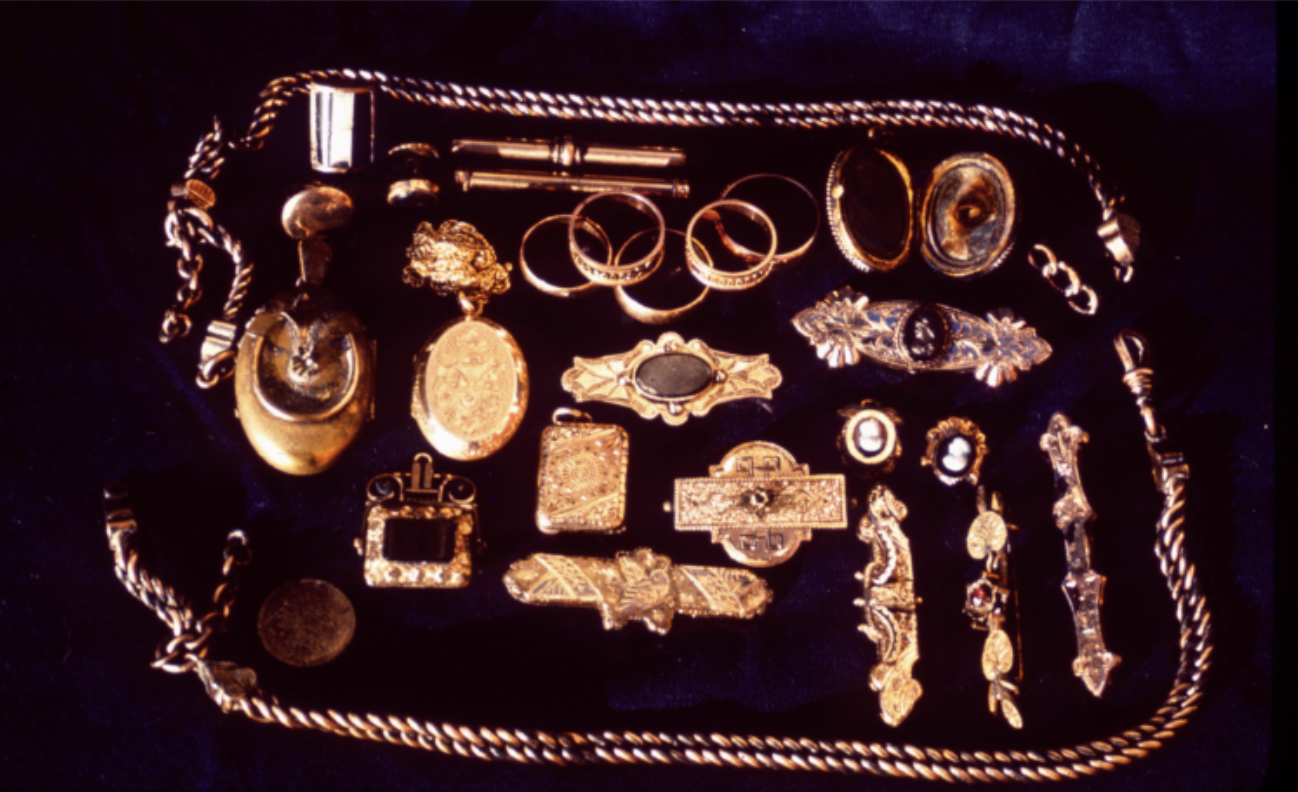
A group of divers met at Port Townsend for bottle hunting and whatever else might be found. Jerry searched the sea floor a short distance from the others. He called out to Al to come over to where he stood in chest deep water and see what he found. Jerry’s two hands were filled with the golden collection shown in the photograph. Al decided that Jerry should pay some price for his lucky find so Al pulled open Jerry’s dry suit zipper allowing “cool” Puget Sound water to fill the suit.
In Between the Bottom and Top circa 1985 by Sherry Gresham
Because my husband Mark and I share the helm at our office, it is difficult for us to take exotic extended dive trips together. I was invited many years ago by a good friend to go with her to Indonesia for a 10-day liveaboard dive trip. Mark convinced me to go. So, when the time came, I was off on my own to Indonesia.
The trip over was uneventful and we arrived in good order, boarded the beautiful traditional sailing ship, then off to dive Raja Ampat. I was probably the least experienced open ocean diver and because I’d had a traumatizing experience diving off an island in the Puget Sound (another story for another time), I found myself a bit uncomfortable once we began diving to just roll off a boat with a bunch of people into the unknown.
We made several dives a day and I began to relax and get into the swing of things. Our crew spoke broken English but were very friendly and attentive.
We made a dive to a deeper coral head than we’d been to and once again I was a bit anxious, but I covered it as best I could. We rolled off the skiff on location and descended to the beautiful coral heads. The soft corals were brilliant and the fish playful. I concentrated on taking the “perfect” picture and all too soon realized I was getting low on air if I was to return to the ship with the required air pressure. And I still needed to make the required safety stop. I typically was the first one low on air. I signaled our dive master that I was prepared to ascend for my safety stop and get out. I was a bit surprised when she signaled “OK” and waved “bye-bye”. I had not realized I would ascend alone.
I rose from about 65 feet and as I did, I watched the coral head recede into the open ocean haze. The most disconcerting feeling was that not only was I watching it recede below, but also off at an angle. I’ve been warned by boat crew in the dive briefs not to go “into the blue”. The warning they gave to stay within sight, insured that you would be seen by the waiting skiffs.
Trying not to panic at this turn of events, I focused on arriving at the appropriate safety stop depth. As I hovered, I looked all around above for some sign of the shadow of the skiff. I could not see any reference above, below, or around me. I persevered all the while saying some prayers and hoping that if they never found me, my husband would remember how much I loved him and all the things you think when you figure the proverbial end might be near.
I completed my safety stop and resigned to my fate I lifted my hand to ascend. It was kind of like when I arrive at a four way stop to turn and put on my turn signal to an empty intersection. Who was I signaling? I was amused at myself and thought “well one last laugh”. It was a good thing that I remembered this training, however, because as I broke the surface, I was practically touching the skiff!
Invasion!! 1958 By Bill High
The Puget Sound Mudshark living club had over 30 members by 1957 and was very active with both scuba and free diving. Club members decided in 1958 to build an artificial fish reef off the Richmond Beach shore north of Seattle. One member had access to two somewhat damaged new VW microbus bodies. We decided they should become part of a new reef.
Ten or more club members carried one body to the water’s edge and loaded it onto two WWII surplus yellow life rafts. We floated it to the desired spot, sank it and free dove to arrange it upright on the sand about 30 feet below. With the job well done, the group swam back to the beach towing the life rafts.
Down the beach came several police officers. “Who are you and what is your purpose” called out the lead officer. Their guns were not drawn but the officers were poised and ready to repel invaders. With our explanation accepted, they reported that they had received phone calls stating that Russian frogmen were attacking from the sea.
In defense of the Richmond Beach homeowners, in 1958 divers were seldom seen and not in such a group. Also, the cold war was beginning.
Squid Dinner circa 1970 By Jim Willoughby
The early morning fog shrouded the waterfront as I walked down Fisherman’s Wharf in Monterey, California. The cold silence was broken only by the mournful sound of a distant foghorn and the cry of gulls searching for their morning meal. As I approached the fish market, the short, pot-bellied fish monger said, “more squid?” I nodded. He weighed out ten pounds of squid and handed it to me wrapped in newspaper. As he wiped his squid-stained hands on his apron, he asked with his thick accent “What the hell do you do with all dem squid?” Selling me ten pounds of squid five mornings in a row had sparked his curiosity.
“I’m feeding the sea otters off cannery row” I said. My pot-bellied friend came back with a sharp “you what?” I explained that I was feeding them to be able to get close enough to film and study them in their own environment. A lively discussion followed, including more obscenities from him, than I had heard in a long time. I was informed that the #!#! sea otters were depleting the abalone, crab and sea urchin population with their #!#! insatiable appetites. So keep my #!#! cameras away from them and furthermore keep your #!#! out of my store! No more squid for you!
The sea otters were always glad to see us as we had been feeding them squid for several days. They were big critters, about seventy or eighty pounds. They would climb up on our shoulders and eat out of our hands. Normally, they dive for food, sometimes to one-hundred and twenty feet. Their favorite food is sea urchins. After surfacing, the otters float on their backs, hold a rock in both paws and hammer it against the sea urchin on their chest. They never leave the ocean. At night, they wrap themselves in kelp so that they won’t drift out to sea, and that is how they sleep. It was truly a unique experience, to be so friendly with wild sea otters. We would sometimes go underwater, with squid in our hands, and they would dive down and take it from us. Talk about an adrenalin rush!
After a long, enjoyable day with the sea otters, I asked the skipper to drop me off at Fisherman’s Wharf. I felt like having a cold beer. I was still wearing my long john underwear under my dry suit. You can imagine the odor by now. I put my jeans on over them, and thongs on my feet. My long, hippie hair didn’t help my appearance either. I walked into the first bar that I came to, (a mangy-looking sports bar), and ordered a beer. As the bartender turned around to get my beer, I glanced up at the tv screen. There was my son Jim, pitching for the Boston Red Sox in the 1975 World Series!!! I said to the bartender “That’s Jim Willoughby!” “Yeah, I know. He pitches for Boston” he answered. I quickly informed him that he was my son. “Sure, sure, drink your beer” he grunted. I showed him my driver’s license, but he still wasn’t convinced. I quoted some of Jim’s pitching stats and finally convinced him. He announced in a loud voice “That beer is on the house!” followed by “Hey, this is Jim Willoughby’s old man!” The next thing I heard was “Give that son of a bitch a beer and “Come sit with us!”
I left that bar so drunk that I couldn’t find my bum with both hands, and never paid for one beer! What a perfect day! Feeding, filming, and playing with wild sea otters, watching my son pitch in the World Series and drinking more beer than I should have!
Catching Porpoise for Science1972 By Gary Loverich
While looking through my diving log recently I noted a short entry “Dec. 12, 1972, vessel Independence. Snorkel dive, 3 hrs., Scuba dive 1 hr., 110 ft.- Loverich and High.” Here is the back story. The Exploratory Fishing and Gear Research arm of the Bureau of Commercial Fisheries was tasked with the study and solution of how to avoid dolphin deaths caused by American Tuna Seiners. Tuna were the target and dolphins the unwanted by-catch. Schools of large tuna follow dolphins so if the fishermen set their nets around dolphins, they often catch large schools of tuna swimming below.
The tuna purse vessel, Independence was chartered to assist in the initial study to determine how porpoise react to being caught in a tuna seine and to provide clues on how to let them escape with few or no mortalities. We set our net on porpoise off California rightly assuming they would react the same as dolphins found much further south. The Independence set its net around several hundred fast swimming porpoises. Since the seines are nearly a mile long and 200 feet deep the net encloses a large volume of water. If the net was set in a perfect circle it looks like a fence of about 1680 ft. in diameter, 200 ft. deep and initially enclosing a volume of 82,000 cubic yards. Once the porpoise are in the net the bottom of the seine is slowly closed up by a purse line running along the bottom edge of the net.
Bill and I dove into the net as soon as we determined porpoise were in the seine: Bill with the camera and I with some sort of a pneumatic shark spear.
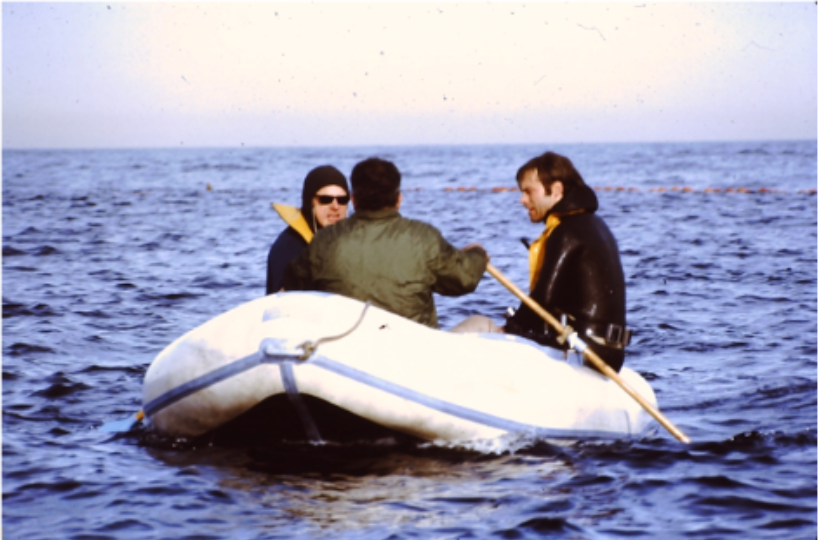
Bill High left and Gary Loverich right
The visibility to be about 60 ft.: great compared to Puget Sound where most of our research diving took place. Initially the porpoise were hard to find in such a large space, but as the bottom of the net was pursed up the diameter of the enclosure decreased and the porpoise began to appear in small groups, at about 30 ft. deep. They were curious and we could see they were looking at us but did not appear agitated. Bill took photos while I watched the activity and looked for any shark captured by accident.
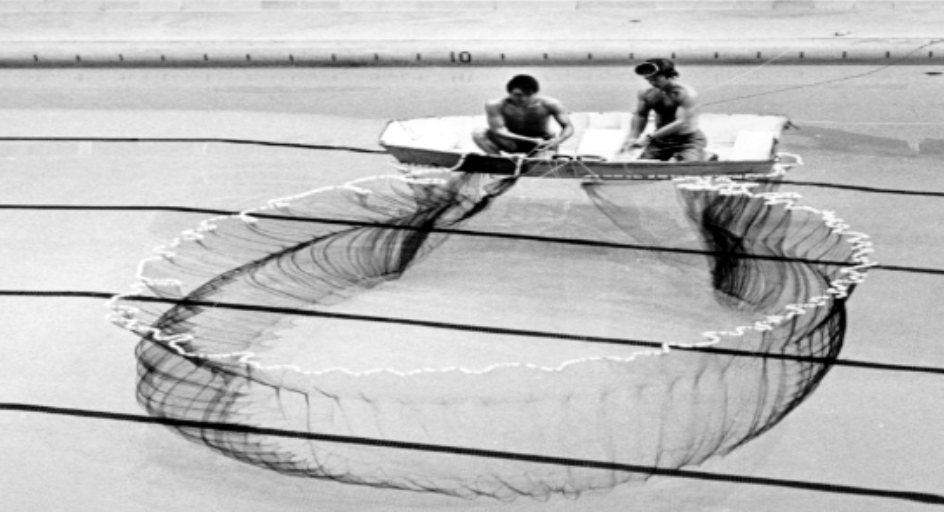
Testing model tuna purse seine in UW swimming pool Prior to the open water test on the Independence, we studied an unusual double purse line in the model. Dan Twohig photoGary Loverich on the right
As the net is pursed up it shallows and begins to deform from the perfect bowl shape that might be imagined. After the bottom is enclosed, one end of the net is slowly brought aboard the vessel and the area in which the fish or porpoise swim is gradually reduced. More important to this study is some of the 200-foot-deep netting rises and slack billows in vertical folds much like a curtain. These folds could trap a porpoise, tuna, or even a diver. Some of the slack netting forms a barrier or roof that does not allow access to the surface. As the net circle closed further some porpoise got trapped under this netting roof and could not get access to the surface to breathe.
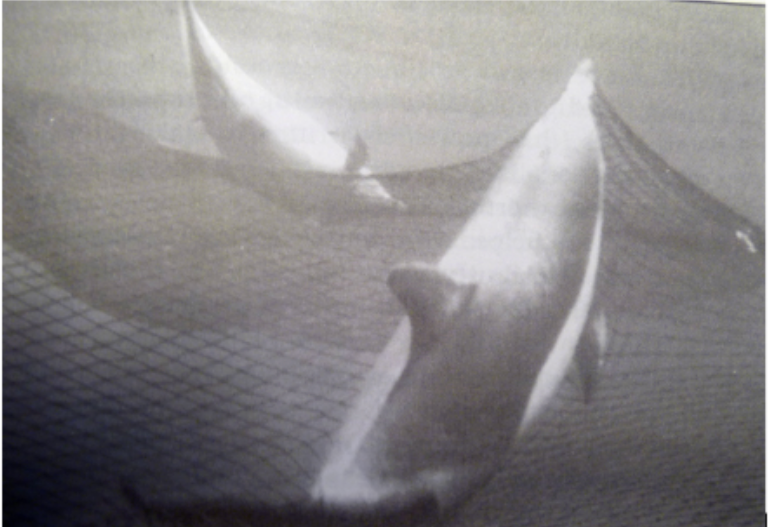
Bill High-photo
Panic ensued as they swam into the net trying to push it to the surface. The mesh size was just large enough to catch their beaks as they twisted and fought for the surface. We saw perhaps as many as 30 caught in this area of the net at a depth of about 15-20 ft.
The purpose of this charter was not to kill porpoise but to study their behavior while captured in a net. We abandoned the camera and spear for a porpoise rescue. Here is where it really got interesting. As we swam into this part of the net the tangled porpoises were almost all caught by their beaks and were thrashing to break free and reach air. In their panicked state we were not sure how the porpoise would react as we neared them: these were large powerful animals. We also did not want to become tangled in the net ourselves. But as we touched these animals all the thrashing stopped, almost as if they were dead and they allowed us to free their beaks from the netting meshes and then push them to where they were free to get air. If we touched them, they allowed us to swim them toward the free surface. I don’t remember how many porpoises we freed this way, but in my mind I felt and still feel these intelligent animals knew we were helping them. Their behavior changing from panic to calm was a complete surprise. There may be other explanations for this behavior, but none seem as compelling to me as some sort of intelligence or understanding. The net was later opened to allow the porpoise to escape.
This was the first of many studies to develop nets and tactics to avoid dolphin mortality, but this human and porpoise interaction was one of the most memorable for me.
Salvage Law circa 1980 By Dennis Lucia
THE BASICS OF SALVAGE LAW or everything you need to know to be a successful salvage diver in 15 minutes.
Seacrest beach was the dive site we instructors in Seattle preferred for open water SCUBA training. I was sitting alone in my dry suit enjoying my PB&J while my SCUBA class had dispersed to get lunch between dives.
I noticed an older gentleman launching his small fishing boat. Once the boat was on the water, he parked his small pickup and trailer in the lot nearby. Returning with tackle box and fishing rod in hand, he paddled out and pulled the starter cord on his small outboard. It sputtered to life, and he was off for a day of fishing with a smile on his face. Preparing to anchor he put his motor in reverse and it jumped off the transom and sank. It seemed he had neglected to tighten the clamps securing the motor to the boat transom.
The man looked down into the water. I’m sure he was thinking, “Damn, I’m not getting that motor back”. His head swiveled toward the beach. He spotted me, surrounded by dive equipment sitting in a dry-suit. He grabbed his oars and made a beeline for the boat ramp. As he approached, I gave him a friendly smile and a hearty “good afternoon” anticipating his initial question.
“Are you a diver”? Yep, I was right. I nodded. He proceeded to inform me that he had just lost his outboard and would I be able to retrieve it? I told him light salvage was within my capability. Of course, he wanted me to go get his motor immediately. I explained I would need to finish my SCUBA class and then I would conduct an underwater search and hopefully find and recover his Evinrude.
Upon finishing and completing the final briefing with my class I wandered over and engaged the gentleman. I told him the cost for the search and recovery dive would be $100. First law of salvage, A salvor either voluntary or contract is entitled to a reasonable and customary fee for salvage if successful. He did not agree the fee was reasonable. In fact, he thought it was outrageous that I would charge him as the motor in question was right in front of the boat ramp, in shallow water, and it should be easy to find.
Second rule of salvage, the reasonable salvage fee is based upon several factors.
That the submerged object is in “Peril of Sea”. More about this later.
The degree of difficulty and hazard involved, i.e., depth, current, environment etc.
The training and skills required of the salvor.
The equipment involved in said salvage operation.
He would not agree to “hire” me. Even after I explained the investment I had made in training and equipment justifying my reasonable fee. In fact, he was quite incensed and stomped back to his truck and empty boat trailer to contemplate his next move. I mounted up a fresh SCUBA cylinder and proceeded toward the boat ramp. I was not surprised to see him walking briskly toward me. I intentionally hesitated before entering the water. “Where are you going”, he asked. “I have it on good authority there is a submerged outboard motor somewhere out there in front of the boat ramp and I intend to recover it", I replied. “That’s my motor and I did not give you permission to go get it” he proclaimed. “Are you able to recover it yourself sir?” I asked. He replied, “No, I am not a diver”. “Then it is in Peril of Sea and anyone with the capability to recover it can do so and is also entitled to a Reasonable and Customary salvage fee”, I advised him.
I could hear him grumbling to himself as I headed down the ramp. Conversation over as far as I was concerned. It did not take me long to return to the ramp with the outboard motor. I left it in the water on the ramp while I dropped my SCUBA rig above the high-water mark. As I hauled the outboard up the ramp, he proceeded to berate me in a loud voice. Next rule of salvage; Maintain possession and control of the recovered salvage prize. Placing it in the bed of my pick-up I stripped off my dry suit doing my best to ignore his ranting and raving about me “stealing” his outboard. Once he realized I was not giving up his motor he simmered down some and offered to pay me the original $100 salvage fee I mentioned.
You can imagine his reaction when I informed him the fee was now $200. The expletives flowed freely. After some time, I suggested he call the sheriff’s office. He stopped yelling as I think he was shocked at my advice. In the quiet that followed I advised him what would happen as I had some experience in these matters.
The deputy would eventually respond to our location. The outboard owner would inform the deputy that I was a thief, and the motor was his. Eventually the officer would hear my side of the story. The only legal option would be for the Sheriff to impound the motor and set a court date for the judge to adjudicate the issue. This would take weeks or even months for a court date to be scheduled. In the meantime, the motor would sit at room temperature in the impound locker and the insides would be rusted beyond repair due to submersion in salt water. The judge upon discovering my reasonable and customary fee for salvage would award me payment from the owner and he would now own a useless motor.
His only course of action to save the motor would be to get it to an outboard mechanic who can open the motor. Clean the salt residue out and treat it with anti-rust solution. This needs to be done immediately. The deputy, who had listened to my logical description of the proper, legal course of action simply looked at the gentleman and said: “What do you want to do, this diver is correct”.
As you can imagine. I was one happy diver heading home with $200 cash. There was a new pair of Jet fins I had my eye on and a stop by the dive shop was on my mind.
CONCLUSION! The final rule of salvage is kind of Dennis’s rule:
“People should be rewarded or penalized according to their attitude be it good or annoying”.
The Surprising Starfish 1995 By Gary Loverich
Approximately 1995-96 we at Ocean Spar Technologies, LLC were testing our first SeaStation offshore fish cage at the NFMS (NOAA) site at Manchester, WA. The cage, 2700 cubic meters in volume and small by contemporary standards, had been in the water for some time and had accumulated a huge mussel set over the early spring. We knew it was time to clean the cage, but weather and other duties at work prevailed and we delayed way too long. And as they are wont to do the mussels grew fast: very fast.
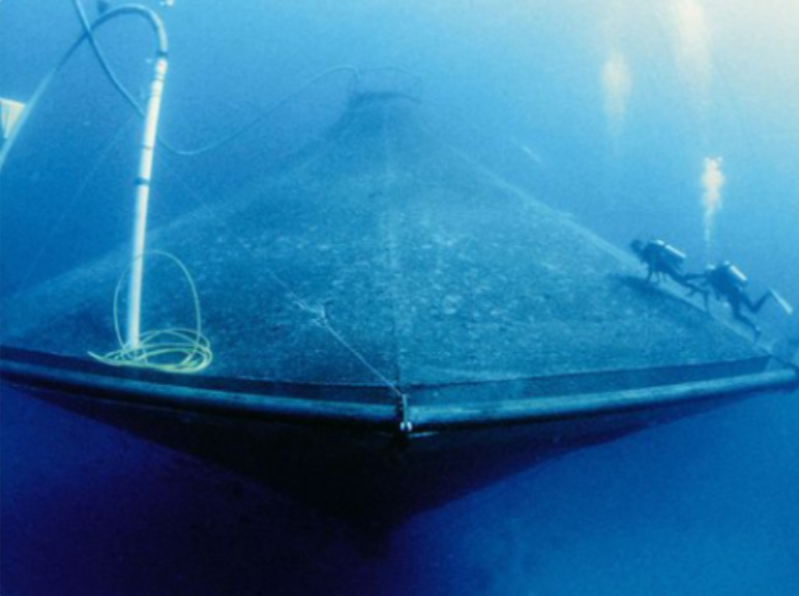
3000 m3 cage in Eleuthera in the Bahamas is very similar to cage at Manchester
But in much clearer water the entire cage could be visualized.
We finally assembled our team of 4 divers to clean the net. At that time, we did not have hydraulic cleaners so we thought we might be able to do it by hand. That was real wishful thinking as the mussels were large and everywhere on the cages 1” square mesh netting. They could be pulled off in clumps, but not easily or fast. After using a single tank of air, we decided to call it quits and look for another solution, possibly buying a hydraulic cleaner. However, when I was near the bottom of the net I
saw many large starfish on the seafloor beneath the cage. I had our divers collect about two dozen and put them at different places on the cages netting. We put them on the top of the net which was easy and for the bottom of the net we had to entangle a leg or two into the meshes to keep them from falling off. Then we headed back to the office.
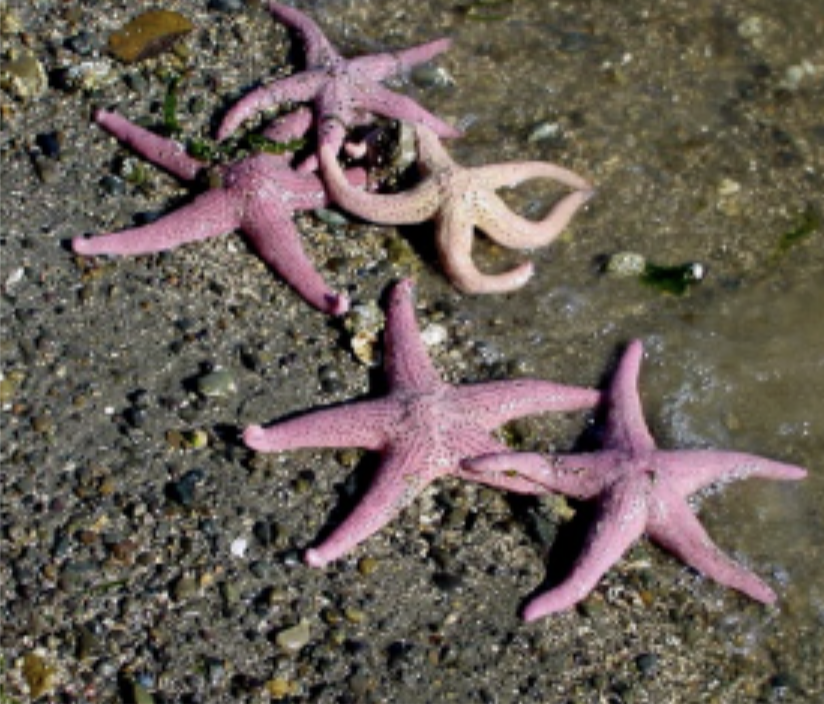
Typical Puget Sound Starfish that we
Employed to work for us.
We continued to put off another cleaning, but around 4 weeks later two of us dove to access the state of the cage. To our surprise it was almost entirely cleaned of mussels and the starfish were still actively feeding; humped up over their juicy dinners. There were still starfish on the underside of the cage, and they had not fallen off in the four weeks of our absence. Beneath the cage on the seafloor was a huge pile of empty mussel shells and there was a large quantity of empty mussel shells in the bottom of the cage where they had not yet fallen through the meshes. It’s not surprising that the starfish eat mussels; they love them. What was surprising is that they were able to stay on the meshes even though currents could be as high as 1.5 kts. Eventually all the starfish left the net as the mussel population diminished. The SeaStation cage has the advantage over traditional gravity cages in that the netting is always taut and does not move and creates folds caused by the current or the motion of the cage. This is the major factor which allowed the sea stars to remain on the cage. It leaves me wondering and surprised about how these creatures can eat so many mussels without appearing to have grown larger? Do they ever get full and stop eating? Has anyone ever studied this?
The lesson I learned from my mentor Bill High remains with me---we often need to dive to understand what really goes on down there; sometimes remote cameras and sensing is not enough. The “ah ha” moment I had when sighting the starfish on the seafloor and our ability to access the starfish would not have occurred if I had just viewed the cage on a video from a remote camera.
Ocean Spar LLC is now Innovasea Systems (innovasea.com) which sells SeaStation cages with volumes up to 16000 cu meters.
Octopus Friends circa 1970 By Tom Hemphill
I recently read an article featuring the most dangerous marine life. Near the top of the list was the giant Pacific octopus. My first thought was – Who wrote this stuff and who honestly thinks that the giant Pacific octopus is dangerous? Obviously, it had to be someone that has never encountered a Pacific octopus underwater and is clueless.
Then I recalled one of my favorite stories of an event that occurred nearly a half a century ago. I was diving in Puget Sound with a Scuba class and a female assistant instructor asked me if I could find an octopus and could she get a close-up look. Sure, I told her. After the class was over, I took the young lady to a spot where we could view Pacific octopus. We dropped down the side of a reef and followed a large crack that angled at about 45 degrees. At around 50 feet, I shined my dive light into the crack and found a small octopus tucked back inside. I moved out of the way and let my dive buddy take a close look.
When I looked up at the reef, I spotted a much larger octopus that was half out of the cave. I moved up close and began petting my new octopus’s friend on the mantle (head) right between its eyes. Then I gently moved some of his arms, one at a time, out of the cave until he was completely free. I continued to pet him (yes, I was able to determine that he was a male) between the eyes and move close so my face mask was almost touching his face. He was opening and closing his eyes as if he really liked the attention. It reminded me of my dog at home when I would stroke her between the eyes.
I took a break and went away to get a couple of small crab nearby. I returned and fed my new friend. Then I resumed rubbing between his eyes and getting close. After a few minutes he lifted an arm and stroked my head above my mask. We were eye-to-eye, and I had tears in my eyes. We communicated in a very friendly way.
I hated to leave, but my air was getting low, and it was time to go. So, I must chuckle a bit when someone refers to the “dangerous” Giant Pacific Octopus.
Trust but Verify Your Mix circa ???? By Mark A. Gresham
Several years ago, I went diving in Florida (exact location not disclosed to prevent embarrassment of the operator.) The dive plan was to descend to the sand at 135 FSW and work our way back to the surface looking at a shipwreck. My dive partner and I were prepping our gear and had requested air as this was the one and only dive that we would make on this day.
We boarded the boat, and our full cylinders were waiting in their respective mounts with bungee’s holding them tight. We retrieved our cylinders from their racks and assembled our kit to expedite the dwell time on the surface. The wind had risen causing choppy 3–4-foot seas making our decision to preassemble our dive kit and dress in our exposure suits prior to departing the dock a smart one!
Our kits assembled, I thought that maybe I should break out my new gas analyzer to become familiar with it and verify my gas. I was proud to show my dive partner my new analyzer and then reread the directions to assure my accuracy. To my surprise the analyzer calibrated almost instantly and was ready for use. I opened my cylinder valve slightly and applied the gauge as the directions indicated. It stabilized immediately and indicated 44% FO2. I immediately shut off the gas and recalibrated the instrument and reapplied it to the slightly open cylinder once again and it immediately indicated 44%.
I know that we asked for air in the cylinders and since they were not labeled for any other gas, I assumed that they were filled with air. The MOD for 44% nitrox is 72 FSW much shallower than the planned dive so I began to wonder if my dive partner’s cylinder was in the same condition. We analyzed his cylinder, and it was air at 21% so it was only my cylinder that was inadvertently filled with nitrox.
I was quite surprised that this could happen, but mistakes are not planned and do occur. The moral of this story is verify your gas prior to diving in a location where rental cylinders are used. If I dove that day this story could not be told!!
Apollo 13 1970 By Bill High
On April 4, 1970, I led a team of 4 scientist divers and one engineer into the undersea habitat Tektite. Our mission was to conduct fisheries and ocean chemistry research. We were also subjected to studies conducted by NASA. While we lived isolated within the undersea habitat and worked out into the surrounding water, NASA scientists studied us. They wanted to learn more about how a team living isolated in a hazardous environment lived, worked, and interacted. That would help them plan for Sky Lab. To carry out that part of our mission, microphones and cameras were placed in each of the 4 habitat living spaces and we were monitored 24 hours per day by NASA teams.
Apollo13 spacecraft was sent on a trip to the moon while we went to live in the sea. NASA thought it would be great publicity if the Astronauts and Aquanauts had voice communication during the simultaneous missions. Several days into our mission, I received the time and moment our joint conversation would be recorded and sent out to the listening world.
The appointed time came, and I made voice contact with the team that would relay our words into space and the Astronaut’s words down into the sea. There was a short delay and suddenly the transmission coordinator reported to me that the communication link was cancelled. We continued with our mission and surfaced nearly two weeks later. I gave the canceled outer space to inner space chat no further thought and nothing more was said. The Apollo 13 disaster was no longer in the news upon our returning to the surface, so we knew nothing about what caused the canceled conversation.
Many years later I was sitting at home watching TV. The movie Apollo 13 was on. Suddenly, it became clear! Our planned conversation between the Apollo 13 crew and my team was cancelled because of the Apollo crisis. We were not told of the crisis as that news might have adversely impacted the study NASA was conducting on our team.
Did that Volkswagen Have Eyes circa 1989 By Dennis Lucia
I was diving in Kodiak, Alaska harbor doing environmental underwater cleanup. I had a full commercial diving crew. As dive supervisor I directed my crew of several divers, and I did daily underwater inspections to inventory what was there so that we could devise a plan to contain and remove the items safely.
During one of these dives my crew topside signaled “RTD” return to deck as there were two Alaska Wildlife Troopers waiting. The troopers requested our services. My crew was also present and listened intently. Odd because they usually would be busy securing the dive station for the day.
Pink and Silver salmon were returning to the Buskin River by the thousands. The Troopers wanted us to snorkel down part of the river and video tape the river bottom, especially the deeper holes where the fish rested during their journey to the spawning grounds.
It seemed a likely assignment and one that we as divers could accomplish. We worked out a dive plan to outfit ourselves in dry suit, mask fins and snorkel and underwater video camera. The troopers would drop us off up-river and we would drift downstream filming as we went.
I should have known something was up as my loyal and faithful crew wanted me to do the actual swim. Their reasoning for this was it would keep them fresh for the next day’s challenging work. Also, they insisted I had the most experience operating the large underwater camera and housing. Go-Pro cameras had not even been thought of then.
So bright and early the troopers transported us upriver. I should have been suspicious as my entire crew was there, on their day off. Oh well they must like my company, or so I thought.
At the briefing I was informed it would be a solo trip. Again, another flag as we normally would send a team for safety. But since it was a snorkeling dive, I was not too concerned. As I entered the river, I thought this was going to be a cake walk on a beautiful day in wild country, easily swimming along with the current, watching the fish. The river changed mood as the miles passed by. I quickly developed a system of swimming and then stopping at a hole or other feature where the salmon hung out. The river was pristine in the Kodiak wilderness. I even felt guilty that we would charge Alaska Fish and Wildlife for this work.
Then to my disappointment I saw IT! On a wide shallow part of the river there was a Volkswagen bug abandoned on the riverbank! How disgusting that someone had simply discarded this eyesore in such a beautiful, pristine place! Then I noticed the car, now shaped like a haystack, had eyes! I was halfway across the shallow river from the “VW”. I stopped and raised up for a clearer look and I realized it was not a cute round car. It was a bear, a huge bear sitting in the shallow at the edge of the river. The bear’s head swiveling to follow my progress down river!
I Immediately lowered my head into the water. Only the top of my head and snorkel showed. Trying not to look like a seal, I’m thinking, do Kodiak brown bears eat seals and do seals come this far upriver? I must look like a log, had to be a log! I remember thinking what the news would say? Commercial diver eaten by a Kodiak brown bear! My adventure was not over. As I continued my drift with the current, I encountered more bears. That didn’t help my state of mind when I remembered the biggest brown bears in the world live on Kodiak Island. Was I scared? Of course not! A 1,500-pound carnivore with paws the size of dinner plates wouldn’t scare a deep-sea diver.
Lucky for the Troopers and my crew I couldn’t run very fast with my flippers on. When I finally got to the boat ramp, they were all waiting. I didn’t even stop to remove my fins. That must have been a sight, me chasing them around the parking lot while they all laughed hysterically at me. I didn’t see the humor in the possibility that I could have been eaten never to be heard from again.
Once I finally ran out of steam things settled down a little. The Game Troopers informed me the bears had been feeding for some time on the spawning salmon. They were so fat and lethargic they simply weren’t interested in the weird creature floating down the river. In fact, they said I could have swatted them on the nose, and they probably wouldn’t lift a paw. Well, this time the joke was on me. How did I even the score? That’s another story.
The Early Days for Edmonds U/W Park 1970-80 By Bruce Higgins
In the 1950’s and 1960’s early divers to Puget Sound north of Seattle visited the Drydock placed next to the Edmonds Ferry terminal. This site became an Underwater Park and has an interesting start. Here are the highlights for those early days the best I can connect the dots and piece stories from those early divers together.
Edmonds had a ferry terminal for the fleet and then the Black Ball Transit Ferry system. In 1935 their ferry operations were disrupted by construction work on Coleman Dock in downtown Seattle so all the cross-Sound service was going to have to go through Edmonds. This led them to place a damaged Drydock next to the ferry slip to make the terminal more dependable with a current barrier.
The DeLion Dry Dock was intentionally placed at Edmonds after an interesting history. First constructed in Port Hadlock in 1893 by Randolf DeLion, the former Port Townsend mayor, as the largest drydock on the west coast as a business venture. Turns out his timing was horrible as the 1893 depression caused him to go bankrupt. He sold the drydock to a group from Tacoma who completed the outfitting for the steam pumps. Then the drydock was moved to Maury Island and became the seed for the Dockton community where it serviced ships until about 1910 when it was relocated to Seacrest in West Seattle to be used during WWI for ‘Pershing’s Bridge’ to build wooden ships to support the war effort in Europe. In 1935, a ship undergoing repair fell against one Drydock wall damaging the structure. The now over 40-year-old dock was not worth repairing. The Drydock was placed at Edmonds later that year. During WWII the exposed Drydock steel walls were salvaged for the war’s metal effort and later the wooden base decayed lowering the drydock underwater.
By the 1950’s the DeLion Drydock had matured with marine life and was an interesting structure to visit and hunt in the early days for scuba. In about 1968, the scuba community tried to have Washington State Parks establish some Underwater Parks in Puget Sound and the San Juan Islands. Well, the pace for State Government was no faster then than today so some local diver store owners, Bob Barringer and Jim McMahon, approached the Edmonds City Council about having an Underwater Park in 1969 at Edmonds to include the DeLion Dry dock. This was parallel with the State’s effort and resulted in a lease agreement with Washington’s Department of Natural Resources (DNR) having Edmonds Underwater Park established in December 1970. The liability rub for the City is what caused the City’s establishment delay. The DeLion Drydock was so magnificent that the City also established the Park as a Marine Protected Area with no marine life harvest allowed.
In 1972 the City arranged with DNR to place the Alitak a previously sunk and abandon tug from Lake Union to be placed at the Underwater Park. The hull was brought nearby for the permits to clear while it rested at what is now Marina Beach in Edmonds (the former Unocal property / fuel pier south of the Port of Edmonds). The Alitak was placed next to the Drydock as the original Park was not very wide north / south and to be within the permit it came to rest just east of the Drydock. This was not what everyone had hoped as on minus tides the tug was exposed. This became a concern as swimmers could visit it and was tempting them to distances, they might not be able to swim back from. The Alitak had been in the Alaska salmon industry until old age caught up with it. Also, the Washington Council of Skin and Scuba Diving Clubs with the local dive store owners provided an old life raft as a resting spot for divers.
In about 1975 a plan was hatched by the State to place a fishing pier in Edmonds so since divers were to be excluded from diving near the pier the State Fisheries Department was going to place a mitigation reef in the Underwater Park to attract divers away from near the pier and the ferry terminal. This effort led to the Underwater Park having its lease extended north to about 27 acres and efforts to cater to the divers’ evolving needs addressed. The fishing pier was completed in 1979 and materials for the mitigation reef were placed north of the Drydock consisting of concrete and a few tires completed in two rounds. This followed the pattern from a reef placed near the fishing pier for Jim Walton’s PhD thesis.
We have a tangent going on in the middle of this effort. In 1977 there were two diving fatalities in the Edmonds Underwater Park. The immediate reaction was to close the Park, which did not stop diving just change the access point to the Park. The Edmonds mayor Harve Harrison appropriately elected to form a safety committee to address the issues the City was facing by having an Underwater Park. I was selected for this committee as I had drawn up a map for the placement for this mitigation feature and had been involved with a survey about what was in these now leased subtidal lands.
The committee’s outcome was to place buoys to define the Park and rest floats to allow divers to catch their breath. To construct these rest floats designed by Fisheries scientist Bill High in cooperation with his Man in the Sea Symposium he donated $1,000 dollars to this effort. I was teaching at Shoreline Community College so directed our Ocean Tech students to deal with the boundary buoys which we received as donations. I was also connected to Bill High’s PE scuba program, so I was able to recruit divers to pitch in on the rest float effort.
Resuming the mitigation reef issue, now with rest floats, divers were learning a new way to dive the Underwater Park and the eye sore issue from the Alitak fading, we had divers ranging all over the Park trying to find the new reef. We had focused on the boundary with our buoys and markers which were placed in late 1979 for the reef did not survive the winter storms. For that matter the rest floats did not have heavy enough anchors, so they were dragging about as well. Since I was key in placing the rest floats, we addressed that issue first. Besides, there was not much life on the concrete yet. Once all the 150# anchors were upgraded to 500# concrete lamp post bases the rest floats seemed to stay put. Then we got busy coping with the steel cable mooring for the rest floats which turned into a routine chore to service them. Still did not have a great solution for marking the reef.
The City’s administration changed and with a new Park Director, the focus changed. But that did not last long as then yet another Park’s Director arrived who was much more marine oriented and got what we were up to. This led to the donation by Divers Institute of Technology tug hull the Fossil (which started life as the Olympian then became the FOSS 16 – the six painted out into an L by DIT). This was a serious move on several fronts. Our volunteer group now seemed to have a seat at the table, and we cooperated with placing the anchors for this new hull and got folded in on permitting placement etc.
To end the early day’s discussion this is when we set up our scope and priorities with the City. The group formed a tiered approach by working on Safety tasks first, then Security items, followed by Maintenance, and last Improvement possibilities. We have tried over what has now become my 46 years (since 1977’s first cooperation) to be faithful to those priorities. The plus side is fatalities have dropped due to the now 2 ½ mile long cement block and line diver trail system plus buoys to indicate the trail intersections. We have labels on some trails to make locating yourself without surfacing much easier.
We have added additional features and focused on biological diversity with low impact and sustainable features as time progressed. The next decade started the diversity effort.
The Boat Motor 2009 by Mark A. Gresham
As divers we are often asked by a friend of a friend to help them find something that has been inadvertently dropped into the water. Some of the most prevalent items are sunglasses, credit cards at fuel docks, and tools in marinas. There are several constants in this world, one is Sir Isaac Newton’s Law of gravitation.
One of the other constants is “this is exactly where I dropped it” which is almost always nowhere near the exact point of gravitation. The person will exclaim vehemently that this is “the spot” often with a heightened tone and hand and arm gestures! It is occasionally true that tidal flow or the shape of the object makes it fall towards the bottom at an angle. There are times when something is dropped in shallow water where it is easily located but these are rare occasions.
As divers, regardless of the size or type of the dropped object, we cannot resist the chase of dropping into low visibility cold water to find it! We all want to be lauded as The Diver who strapped on his kit, jumped into the cold and murky water to locate the great lost object. I have done this many times and will likely still fall into this trap of being The Diver.
On one such occasion a person contacted me asking if I would be able to help him find his brother’s lost boat motor. I asked him if he was a diver, he quickly answered no way. Then I asked if he knew where it was located, and he again quickly said no but his brother did. I then wondered what he meant by “help him”. Was he going to assist me or was he going to pull the located motor to the surface? This was not a case of helping - it was clearly a case of doing for him usually meaning at no charge. It is a common theme to help someone find their friend, brother or associate’s dropped item meaning there is no chance of remuneration.
I loaded my dive kit and cylinders in my truck and drove to the dive shop to fill a couple of extra cylinders because locating a lost item in the water is almost impossible to do in just one dive. Upon arriving at the meeting location to formulate a plan it was revealed that the black colored 25 HP Mercury motor came off the transom at least 75 feet freshwater (they thought!?!). Lake Sammamish is a mountain water fed lake that is approximately 105-110 feet deep and 7 miles long by 1.5 miles wide. Another factor that could make this location and discovery quite difficult is the bottom is comprised of many feet of dark black silt and mud. One can see the potential magnitude of the problem if the motor is in or near the deepest portion of the lake.
Assembling my dive kit and loading it into the boat provided by the person who contacted me to help find his brother’s boat motor we set off to the “exact spot” where the motor became detached from the boat while trolling for fish. Upon arriving at the “exact spot” I spent a few minutes using a hand compass to shoot an azimuth at two fixed items on the shore then deployed a weighted buoy as a reference point. I then dressed in my dry suit because water temperatures were around 45 degrees f on the surface and likely colder at 75 feet. I donned my dive kit, completed a predive check, and performed a back roll into the cold lake following the line as a reference point while descending. At 50 feet I turned on my 5000-lumen canister light to try and locate the bottom. I was able to stabilize my descent using my well honed buoyancy skills (due to my previous multiple attempts to be The Diver) and stopped just above the dark black silt bottom. I shined my light to the left and there it was! The weight on the marker buoy was 6 inches from the motor! The boat motor was exactly where he said it was and I am glad no one could see my cold dumbfounded look of amazement!
I switched into recovery mode, attaching a lift bag to the motor and began to fill it with a small amount of air to prepare to lift it. I started adding small quantities of air to the bag to slowly make it buoyant and began to lift it while swimming up counting on Boyles Law to do the rest. The motor slowly rose to the surface with venting of the bag required to prevent a rapid ascent and breach which would have emptied the bag sending the bag motor and all back to the bottom. I arrived at the surface along with the lift bag simultaneously with no issues while venting most of the way to the surface. The owner and his brother were extremely excited and so was I to be The Diver!
I learned several things that day. The first being that dropped items can be exactly where they were dropped and the second is a boat motor dropped in 75 feet of water in a dark and muddy lake can really be located and recovered. And lastly, it is still a constant that you still do not get paid to find your friend of a friend’s dropped boat motor even if you are The Diver!
No Nitrox for You! 2015 by Mark and Sherry Gresham
William (Bill) High, the founder of Professional Scuba Inspectors (PSI) was inducted into the International Diving Hall of Fame in September 2015. The ceremony took place in the Cayman Islands on Grand Cayman. Bill and his son Jeff were accompanied to Grand Cayman by Mark and Sherry Gresham arriving a few days prior to the induction ceremony to take the opportunity to go diving.
The day after arrival the four of us went to the dive shop on the facility grounds where we were staying to sign up for dives and get our diving ensemble and cylinders for the dive. We were asked to fill out the common hold harmless paperwork and to show our diving credentials. The first sign of trouble was when the dive store clerk read Bill’s paperwork and responded with a sarcastic retort. She exclaimed “there is no way” when she read the number of dives Bill had written on his form, “about 10,000” and then said, “no C card, no nitrox”! She made these comments as she snatched the document from the counter while turning to walk away in huff.
Mark continues the story. I intervened and asked her if she knew who Bill was and what his relevant background is, and was met with another sarcastic retort, “I don’t care who he is”! I was certainly taken aback by her reticence to offer customer service and provide the requested cylinders. Of course, no such card existed when the team developed the gas for diving.
I stood back from the counter to take a moment to formulate a response to persuade her to listen and react appropriately. I asked her to come back to the counter so we could discuss this and tried to convince her that Bill’s request for a nitrox filled cylinder was legitimate and she should provide the cylinder to which she responded, “NO C card, NO nitrox! I then took a more aggressive approach and demanded she return to the counter and must listen to him - I explained that Bill was on the National Oceanographic and Atmosphere Administration (NOAA) team in the 1970’s who invented enriched air (nitrox) and was the former Director of NOAA’s Diving program. Again, I struck out as she vehemently refused to amend her strong position and walked away, the stalemate continued!
For the second time I stood away from the counter to formulate my game plan. When I reached the counter, I asked for my equipment form so I could amend my request which she complied with immediately. I quickly lined through my request for one nitrox cylinder and filled in the space with the word two.
The store clerk started retrieving dive gear from the drying racks and made piles of gear for each of us. Once all the soft goods were provided, she went to the cylinder storage shed to retrieve the cylinders. Without a comment or question she marked two cylinders with blue tape writing my name on both and placed them in the rack to be moved to the boat thus ending the nitrox stalemate!
Bill, Jeff, Sherry, and I enjoyed several very nice dives in Grand Cayman that day and several more on the following days without any further comments or “No Nitrox for YOU” being uttered.
Lopez Pontoon – an ongoing saga 2007-2020 By Bruce Higgins
At the Edmonds Underwater Park, we add features that divers will find interesting. In 1999 we placed the Triumph hull – a former tugboat – as a diver feature. Over time it decomposed. In 2007 we were offered a replacement as the wooden remains were a shadow of the former feature. This story is the path to its replacement.
In June 2007 General Construction (GC) completed a project to replace a floating fender for the Washington State Ferry at the Lopez Island Terminal. As the new fender was placed, they took over control of the Lopez Pontoon. It was offered to the City of Edmonds as a possible diver feature. GC heard from Manson Construction that we used some stray concrete during their work at the Edmonds Ferry Terminal in 1995 as a Park feature so thought of us. The City and our volunteer effort thought it might be a nice and more permanent replacement for the failing Triumph hull. We got back to GC with a plan.
The plan started with some basic constraints in that the City would ask DNR (Washington Department of Natural Resources) who the Park is leased from if this was a possibility. Together we started gathering the information for filling the permits required. That took several months and DNR said it seemed like a suitable replacement for the Triumph.
Late in 2007 we got the details for the Pontoon from GC and visited it to see if it was a possible go. All looked good to us. In early 2008 the City had the completed permit application, and we finished a survey of the proposed site. The Triumph was located with the bow to the north and stern south and to our disappointment the port side was down to the west. That made the internal structure take the full storm wave forces. The manways (entries) into the compartments needed a second opening so divers would have both an entry and exit GC agreed that this would be an important safety feature and no problem to complete since we were not on some tight rush as permitting had just began.
In the summer of 2008, there was an issue with DNR. They were concerned about the Pontoon’s size. We had completed the paperwork and had only added more information about endangered species and from other agencies, but they wanted a meeting to discuss the plan. The meeting was held, and their representatives were sent to kill the deal. During the meeting it became clear they had said yes to the plan but had not read the draft carefully as what they were objecting to had been there from the start which seemed to have not been noticed – misread at the time – or too lazy to pay any attention to.
The Pontoon had started life as a fender for the 520 bridge in 1963. It was nominally 100 feet long, 19 feet wide, and 13 feet tall shaped like a parallelogram. My math said it was about 300 tons with a 12-inch base, 9-inch walls, and 6 inch overhead as a series of 7 compartments. At the meeting’s end we had agreed to their changes in the placement details, but it needed to complete the review process which still had other agencies that needed to chime in. There were two big rubs for DNR.
First, we had planned to place it on the Triumph’s engine block as a spacer off the bottom so there would be hiding under the Pontoon for critters and retain the prior footprint. This was a huge concern as they were opposed to engine blocks being placed – granted this one was already there as were others from the 1920’s into 1940’s used as anchors in the Park during its’ shingle mill days. They wanted us to remove the engine block but since this was a 4-cylinder diesel direct drive we finally convinced them that removal was going to be a very disruptive task (plus it was already permitted). This was a marine engine weighing tons. We agreed to remove the bow winch and water tank. The fuel tanks were too decayed to remove and would end up as pieces.
Second, DNR was concerned that the Pontoon’s footprint would be larger than the footprint from the Triumph. We explained our logic for placing it off the bottom with the spacer was to address just that very issue. But if we could not place it on the engine block, we would provide other spacer material and accomplish this goal. The meeting concluded with us continuing to move forward but we needed to tag this conclusion as it will return.
Since all seemed in place as the permitting proceeded, we increased coordination with GC. We informed them about the spacer issue, and they would hatch a plan as would we and agree once we had time to figure it out. We also had a request for preparation in that each of the five main chambers would need a second opening other than the original man way so a buddy team would have an exit for each diver if someone got hung up in the smaller existing man ways (2x5ft) and was hoping for an additional 3x6 opening on the alternate side. GC elected to place a pair of steel pontoons on the Lopez Pontoon as it was sagging during the paperwork phase while stored on the Duwamish River and would sink without additional support.
Time passed and we placed a rope outline on the bottom where the Lopez Pontoon was to be placed held in place by blocks and corner pallets so we could navigate the area in more limited visibility. We then placed a spine down the site’s main axis made from concrete pieces relocated from the Enhancement about 400feet south. We also removed the bow winch and water tank from the Triumph. The water tank was rusting so it was delicate and only made it a short distance before it needed to be set down.
Since we had the time, we planned to wrap the Pontoon with vertical ropes so we could climb the sides which were 13 feet tall and hang things off them for structure. We placed ropes about every 15 ft at right angles to the axis so we would not have to puzzle how we could place ropes under it once placed. As a spacer on the south end, we placed a boat hull – the Ol’ Blue - and filled it with the concrete which had been hulled out in the Triumph, Mesmerized, Glacie, and Genius 1. The hull was quite full, so the plan was for the Lopez Pontoon to rest the south end on this. Then to work on a spacer for the north end with a second hull and the balance of the remaining concrete doing a good job repurposing all the earlier ballast for a spacer if it slid north. We also placed some concrete footers from the Enhancement in the footprint as well. We had time as the permitting took 22 months.
During the delay we lost the chance for the concrete which GC had removed from the Lopez Pontoon’s deck which had been counterweights for the rub rails on one side. Ecology Blocks became the replacement to support the expected spacer and on the south end since more violent storms came from the north and northwest having the south end become the end spaced up off the bottom.
The clock had ticked on and finally the construction window opened, and permission was granted based on salmon migration and the project went ahead in early November 2009. We were able to watch from shore as the two tugs hauled the Lopez Pontoon and a spud barge to the site to place things. We had previously placed the SE and NE buoys to indicate the corners for the site as references which GC confirmed with details on the plan and permitted location. They took soundings to confirm what we had claimed to have completed and the Triumph’s status. The placement process included several steps and about 10 hours after arrival it was on the bottom per the permit. We dove the site just before dark to salvage supplies for GC as they had some hoses, fittings, and loose parts that we could return to them.
The following weekend we headed out to do a more complete inspection and started the projects that only we could accomplish once it was in place. The first effort was to remove all the stray pieces from inside the chambers as when the top was cut with a diamond saw for the exits, we requested the slabs just fell to the base. We removed them and used them as spacers along with ecology blocks which we placed on the east side as spacers to keep the intended lean and space off the sea floor.
Once that was complete there were spaces in the tops of the chambers which held air which we suspected some diver might intend to breathe from. We got some star drills and a pneumatic chipper and created a series of twelve holes as vents so limited air / gas could be held in the tops of the chambers. This was not a fun effort as it was now winter when these efforts continued. We worked in rounds as it was not simple to make the over one-inch holes in the 6 inch thick concrete. But the process worked and there would never be a temptation as the gas from diver visits inside the chambers would just bubble out.
Then we did the loops over the structure with the ropes we had placed and that was useful as it provided a method to ascent the steep sides. We also found some ladders inside so attached those on the outside as well. We move over some concrete building footers from the Enhancement as well as concrete boxes (8x4x2.5 feet hollow) as decorations as well.
The big effort the summer after placement was to place some concrete piles up against the Pontoon. Prior to the permit being granted the City / WADOT were removing the Unocal Pier at the City’s Marina Beach as part of a plan to relocate the Ferry terminal to just south of the Port of Edmonds breakwater as part of the Edmonds Crossing project slated for 2012. We explored the site and there were concrete pilings between 45 and 55 feet long on the bottom there. Prior to the Manson Construction effort to remove the pier we were able to mussel one – using a boat – north into the Underwater Park for use next to the Pontoon when it arrived. There were others but our timing in late 2008 did not have good weather and moving the first one was very taxing.
In July 2010 we were able to place the first pile against the Pontoon’s north end. It was the smallest and was about 9,000# making it our largest lift to date and we were able to secure it to the Pontoon with lines and an ecology block. Over the next three years we were able to recover 3 additional pilings and place two on the north end making a nice pattern there and one to the southeast eventually connecting the Triumph’s engine block to the Pontoon with a nice swim under.
Decorations continued by locating culvert from other Park sites as we deprecated the southern Park to keep divers away from the Ferry Terminal. After about 5 years we moved to a more maintenance mode for the Pontoon placing just limited additions there as available.
I mentioned there was a place holder earlier in this description. During the 2008 summer meeting with DNR they had agreed to our spacing off the bottom but did not want us to use the engine block from the Triumph. Months after the meeting the City received a letter from DNR stating a number of conditions which were not agreed to in the meeting. The letter got filed by the City as plans based on the meeting had been shared from the minutes we had taken only to be shared in Fall 2020. Well too late the Pontoon was placed per the agreement at the meeting. All I can say in hindsight is based on the letter the DNR representatives were not representatives as their words were not honored by the agency that had sent them. This letter was not reflected in the final permit granted to the City which was signed by DNR during the 12 months following the meeting.
A chilly 10 minutes circa 1965 by Jim Willoughby
Some time ago, I received a phone call from the National Enquirer. Just so that you don’t get it confused with National Geographic, the National Enquirer is a publication like the ones you find at the checkout counter of your local grocery store. They were told that I had an extensive collection of photos of the Giant Pacific Octopus, the largest octopus in the world. They wanted a photo of a female diver holding this octopus and wanted to publish it with a story about the Giant Pacific Octopus. I agreed to send them several slides, providing that the article did not make the octopus out to be a “slimy denizen of the deep who sinks ships and eats the crew.” They assured me that they would not do that.
We came to an agreement on my fee, and I sent them an assortment of slides to choose from. In about a week I received another call from them, complaining that the girl was wearing a wet suit. They informed me that she must have on a bikini bathing suit. After collecting myself, I advised them of the water temperature in British Columbia. In a few words, it is “very cold!” That didn’t seem to bother them as they still wanted to know if I could meet their request. After further wage negotiations, my fee going up considerably, they agreed. When I hung up the phone, I wondered which insane asylum to check into.
After an extensive search, I finally found a girl who met the criteria. Previously, I had done some underwater photography at the Undersea Gardens in Victoria, B.C. I called them and explained the situation to the Curator. He thought it would be great publicity for his business, and readily accepted my proposal. To get to the viewing area of the Undersea Gardens, you walk down a flight of stairs which takes you below sea level (but in a dry environment). You can then look through huge windows at what is actually part of the ocean. You can view all of the undersea life that you would see in the open ocean. The only difference is that the undersea life are in an enclosed area and can’t get out. It is much like an aquarium but is part of the ocean. The Curator informed me that they had recently captured a Giant Pacific Octopus and that it was in the viewing area. We agreed on a date to accomplish my unusual request, and now it was about to happen!
As my diving buddy, David, and I submerged ourselves into the beautiful Undersea Gardens, the sight was breathtaking! We were in an enclosed area about twelve feet deep containing colorful rockfish, anemones, the head of a large male wolf eel jutting out from a rocky cave, and so much more. But our mission was not about any of these creatures. We were looking for the elusive Giant Pacific Octopus. David’s job was to find the octopus, and bring it to Miriam, our bikini-clad model. My sole job was to take as many pictures of her holding it, as I could, for the short time that she could endure the frigid water (in her bikini!).
David found the octopus, after searching most of the caves, as that’s the environment they prefer. As David wrestled it from its lair, its never-ending sucker discs, tentacles and mantle came pouring out, squirting ink which landed squarely on David. After a brief struggle he brought the octopus into position for the series of pictures that I was determined to get.
It was a cold, bleak November day, as a brisk wind blew the rain in sheets across Victoria Harbour. Miriam stood there poised, clad only in a brief, green bikini, and her diving gear. She was covered with a huge blanket to keep her warm. She looked down into the clear, cold ocean that was patiently waiting to engulf her in its nine-degree centigrade water. As I gave her the signal, she jumped with grim determination and lots of sheer guts, knowing she was about to accomplish what few people have ever attempted. With a quiet splash, the icy waters of Victoria’s Undersea Gardens closed over her, beginning an experience she would never forget. Wrestling a giant octopus, even in a wet suit, is difficult, but to do it in a bikini is almost impossible. She landed on the exact spot that I was signaling her to use.
David handed her the octopus. The next few minutes were filled with ink, sucker discs, excitement, and an occasional glimpse of Miriam, who almost lost her tank once and her mask twice. Amid this chaotic confusion, it was my job to frame this writhing mass of tentacles, with Miriam for 1/60th of a second. After an amazing ten minutes immersed in the icy waters, wrestling with this huge creature, Miriam’s limit of endurance was reached.
From the cold waters of the Undersea Gardens emerged a tired, shaken, but very brave girl. She knew she had probably set a record-ten minutes in the chilling Victoria Harbour with only a bikini and a giant octopus to keep her warm. The National Enquirer was very excited about the pictures I sent them. They published the photo and the article to a public who will never know how difficult it is to get an underwater snapshot of a girl in a bikini holding a Giant Pacific Octopus!
Story Contributors
Sherry Gresham: Co-owner and Vice President of Operations at PSI-PCI, Inc. 2005-current, (founded 1982 as Professional Scuba Inspectors). Certified cylinder inspector Instructor. Sport diver enthusiast since 1991. Graduate of Cathy Church Photo fest Grand Cayman. Underwater photographer since 2012.
Mark Gresham: Co-owner and President/CEO of PSI-PCI 2005-current, began diving in Florida in 1977, U.S Marine Corps 1981-1991, dive store manager, cylinder safety consultant to NASA, cylinder manufacturers, others.
Tom Hemphill: Began diving with mask and fins in 1954 at age 10, began scuba diving 1959, NAUI instructor, dive store owner, NAUI Board of Director 16 years, Chairman of the Northwest Diving History Association.
Bruce Higgins: Ocean Engineer, scuba training at U. of Michigan 1970, NAUI instructor 1977, research diver for Battelle Marine Sciences Lab in Sequim WA., scuba Instructor at Shoreline Community College, leading force for Edmonds Underwater Park 1978-current.
William (Bill) High: Began diving in 1955. Fisheries Research Biologist 1958. President, Washington Council of Skin-Diving Clubs 1960-61. US Aquanaut, 1969-75. US representative to United Nations Man in the Sea Committee 1970-73. President, NAUI 1976-1980. Founder, Professional Scuba Inspectors, Inc 1982. Recipient of NOGI awards (sports education, Science, and Distinguished Service). International Scuba Diving Hall of Fame, 2015.
Gary Loverich: BS Aeronautics and Astronautics, UW 1968. Ocean Engineering, MIT and UW 1968-73 (part time). Research and Design Engineer NMFS 1973-1978. CEO and Chief Engineer at Nor’Eastern Trawl Systems, LLC Inventor of Ocean Spar and Sea Station offshore aquaculture cages-1990, 1994 respectively, 1995-2008 Engineer at Ocean Spar Technologies, LLC 2010-2020. Engineer for InnovaSea Systems LLC. Retired 2020
Dennis Lucia: Commercial diver/instructor, NAUI scuba instructor #4799, developed harvest diver training for 13 Northwest Tribes, Diving Supervisor for US Navy contractor Science Applications Intl., USCG 100-ton Master, semi-retired.
Daniel J Twohig: Edison Technical School Seattle Electronics1962-1964, Electronics Tech USC&GS Seattle 1966-1969, BCF Seattle 1969-1974, NMFS Midwater Assessment and Conservation Engineering program 1974-2001, Fisheries on-site representative for construction, and delivery of the NOAA Ship Oscar Dyson 2001-2005.
Jim Willoughby: (none provided)