The Women's Room at 240 Feet
by Eric Morris
At midnight, on March 31, 1921, the SS Governor was steaming southbound from Victoria, British Columbia, toward Seattle. The Governor was a handsome, two-smokestack liner, 417 feet long and displacing 5,474 tons. For the time, it was considered a luxury coastal liner, running regular service between San Francisco and Seattle/Victoria. With twin 5,000-hp oil-burning engines, the Governor had set a San Francisco–to–Seattle record of 49 hours, dock to dock.
This was to be its last trip, for as the Governor was passing Port Townsend, out of the darkness came the freighter West Hartland, which sliced deep into the starboard side of the Governor, nearly cutting the liner in half. The captain of the West Hartland did the intelligent thing—instead of backing out his ship and letting water immediately sink the Governor, he ordered full speed ahead to keep the two ships locked together, with the freighter now acting as a giant plug. This important decision saved the passengers of the Governor, who were able to scramble up onto the freighter’s bow to safety—except for eight unlucky souls who died trapped in their cabins.
The Governor sank fast, with the stern dropping quickly until the bow towered 150 feet skyward. As air hissed out of the portholes and hatches, the bow began submerging, and within twenty minutes of the collision, the Governor settled on the bottom between the Port Townsend lighthouse and Whidbey Island. Within a decade, the liner was forgotten by all but a few old-timers.
Fifty-four years later, a diver by the name of Ron Bohlender did some research and thought he knew where the Governor might lie. Ron was a big wreck hound and owned the salvage rights to the SS Andalusa, sunk up near Sekiu, but he knew the Governor was beyond his diving limits.
He needed a couple of experienced yet foolhardy young men to make this deep dive and prove his theory.
In 1975, two young men in the Puget Sound diving community who met his requirements were me and my partner, Kelly Finn. We were well known for pioneering deep dives on Duntz Rock, a pinnacle in the open ocean off Neah Bay. Many of these dives were beyond 200 feet on compressed air, which led people to mistakenly think that Duntz Rock was named after us as a reward for our exploration—even if they got the spelling wrong.
Bohlender looked Kelly and me up. Within minutes, he knew that the rumors were true—he had found his duntz divers.
Kelly volunteered as soon as Ron said the word “Governor.” I wasn’t so sure—I really just wanted to teach scuba classes, ogle the female students, and have an occasional beer after class. Diving below 200 feet in mid-channel sounded mighty risky—even before the occasional beer, and downright suicidal after it.
I pointed out that the depths where the wreck was supposed to be were over 400 feet, thinking this would surely put an end to the madness. But to my surprise, Ron showed me an old insurance report filed right after the sinking. After the accident, it seemed two ships had steamed a parallel course over the area with a cable strung between them. The cable hung up on the wreck and thus revealed its location—in only 260 feet of water. Ron unrolled a nautical chart showing a small underwater mound off Port Townsend that rose to within 240 feet of the surface. He figured the wreck had to be on that mound.
I tried to wiggle out again by mentioning that the mound—and therefore the wreck—was right smack in the middle of busy shipping lanes. How could we anchor a support boat over the wreck and do our decompression stops if freighters ran over us?
Ron had already cleared things with Puget Sound Traffic Control and the Coast Guard, who would put out a bulletin to alert shipping of our whereabouts and direct vessels around us. He had also chartered a commercial fishing boat with state-of-the-art sonar, enlisted safety divers to stand by, secured a two-inch-thick anchoring line with a grapple, and even arranged spare tanks for decompression. Ron had this so thoroughly planned out that I couldn’t say no—my standing in the dive community would have plummeted.
The deciding factor was Kelly, who looked at me expectantly like a dog begging for a biscuit—if the biscuit were 240 feet underwater and possibly fatal. So I agreed.
They didn’t call us foolhardy for nothing.
The charter boat left port on a hot August day when the tides were nearly slack. After seven hours of searching, we hadn’t found a thing on the sonar, and the boat was drifting while we discussed our options. I thought we should give up and go dive the coastline for fun.
Everyone had just agreed to this change of venue when, wouldn’t you know it, the chart recorder showed a blip on the screen—a very conspicuous object poking 40 feet off the bottom. After a couple of passes, we set the grapple hook, and it stopped the boat with a jerk.
We were anchored to something in 260 feet of water.
The question was: wreck or rock? No way to tell unless two dunces went down to find out.
As we struggled to don our heavy, awkward triple-80 tanks, I nervously looked around. It was daunting to be jumping into the water halfway between Port Townsend and Whidbey Island and expect to find bottom before croaking—those two landmasses are a long way apart.
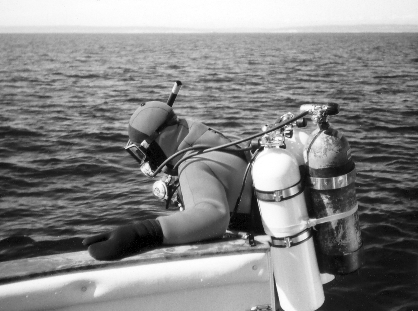
We might run into China before we ran into the Governor.
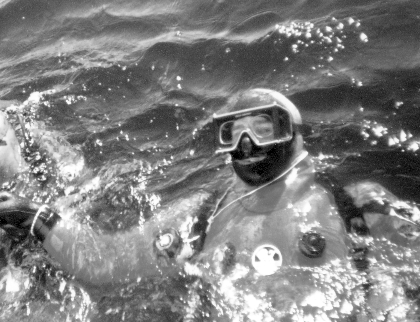
The author just before the descent, waiting for the current to slow.
Once in the water, Kelly and I pulled ourselves down the anchor line, struggling against the drag of triple tanks in a still-moving tide. By the time we reached 180 feet, we had used one-third of our air and still saw nothing but anchor line stretching into the depths.
Topside, modern freighters chugged past, their throbbing engines magnified through the water column, surrounding us in a symphony of rising and ebbing vibrations. It was eerie—unlike any diving I’d done before, where I normally had a reference point of rock wall or mud bottom.
Nitrogen narcosis had hit us hard—somewhere around 190 feet my brain quietly excused itself from duty and went out for a drink.
We reached 200 feet. At that depth, every breath was laborious, drawing dense air through our regulators, hearing the metallic roar of exhaust bubbles spiraling upward.
Finally, at 230 feet, we made out rows of white anemones. By then I was so buzzed with narcosis that I hardly knew which way was up or down, but I was sure glad to see something besides that white anchor line.
We pulled ourselves the last twenty feet and landed on an anemone-covered metal deck beam—the wood decking long since eaten away by boring worms. In fact, all the wood on the ship had disappeared, leaving only a massive metal shell thickly coated with marine life.
Kelly and I wrapped our legs around the beams to hold position while we numbly checked our gauges. I don’t remember what they read, but we must have had enough air—we kept going.
One thing was certain: as narced as we were, there was no doubt we were on a wreck—and a large one. Huge yelloweye rockfish swam right up to us, so big and tame they formed a living wall we had to push aside. Massive lingcod circled us, curious as neighborhood dogs.
We moved from beam to beam, shining our lights into the structure and down into staterooms. Time seemed slowed, like a film run at the wrong speed.
I had to concentrate just to keep my regulator in my mouth—more than once I discovered it had fallen out—which is not the sort of thing you want to discover calmly at 230 feet.
At one point, I found a men’s restroom, dropped in, and tried to tear a urinal off the wall. It wouldn’t budge—something for which I’ve always been profoundly grateful.
A urinal is not exactly a great wreck trophy—even if it did come off the Governor.
In the room across the hall, I grabbed a couple of small bronze items and dropped them into my goodie bag, though I was too narced to know what they were.
We swam in an arc about seventy-five feet around the anchor line. At one point, I think we passed one of the stumps from a smokestack, but in the darkness—and with our minds as sharp as overcooked oatmeal—it was hard to tell. Kelly found something bronze and dropped it into his goody bag.
Then I saw it—a green glass beer pitcher lying on the deck.
This was a find.
I imagined pouring beer for my dive buddies from a pitcher recovered from the Governor. They’d be envious as hell—or at least admit that I’d finally done something impressive. This would elevate my standing instantly.
It was a must-have trophy. In my mind, this pitcher had already earned a permanent place of honor on my bar shelf.
It was heavy, and I had to add a lot of air to my dry suit to maintain buoyancy. By now, we’d both run out of air in our main tanks and switched to our reserve. It was time to go.
We found the anchor line and began our ascent. The current helped pull us upward, and gradually the narcosis faded.
At 150 feet, we met Terry Gallion, our safety diver, who handed us fresh tanks and helped us swap out our triples.
He reached for my beer pitcher—I handed it over—and he promptly sank toward the bottom.
For a moment, I thought we’d have to rescue him, but he inflated his dry suit like a balloon and clawed his way back to the line.
Meanwhile, without the pitcher, I was suddenly far too buoyant and had to vent air quickly to avoid an uncontrolled ascent.
We completed our decompression stops—over an hour hanging on the line, flapping like signal flags in the current. At one point, I noticed my depth gauge was stuck at 240 feet—it had experienced a fatal dive. Better it than me.
I still have that gauge on my artifacts shelf.
By now, the narcosis was gone. Kelly and I just stared at each other, shaking our heads in disbelief.
We finally surfaced, cold and exhausted, and climbed aboard to cheers. Ron was thrilled—we had proven the wreck’s location and that it was diveable.
Kelly opened his goody bag and revealed a beautiful green glass ship’s light in a bronze cage.
And my prize?
That “beer pitcher” I’d hauled up from 240 feet turned out to be an ugly bronze gate valve—the kind used on a fire hose or to ruin a perfectly good story.
Fifteen pounds of corroded disappointment.
I had risked my life, burned through three tanks of air, and nearly inverted my buoyancy—for plumbing.
A perfect case of mistaken identity.
There was one small item in my goody bag.
A green bronze door plaque that read—
Women’s Toilet
Which, in hindsight, was the only accurate identification I made the entire dive.
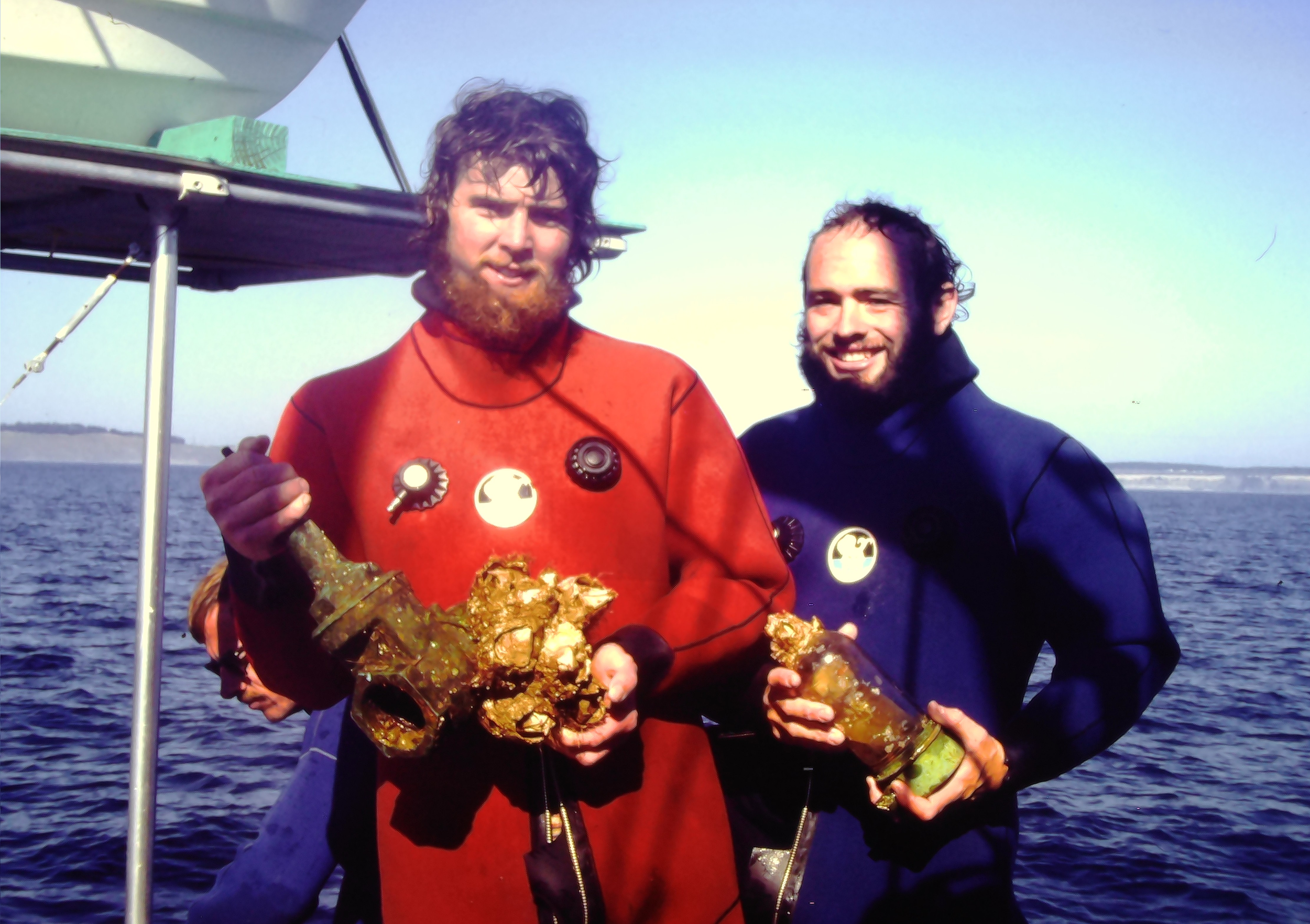
Eric Morris and Kelly Finn with proof of their dive on the SS Governor